
 By Admin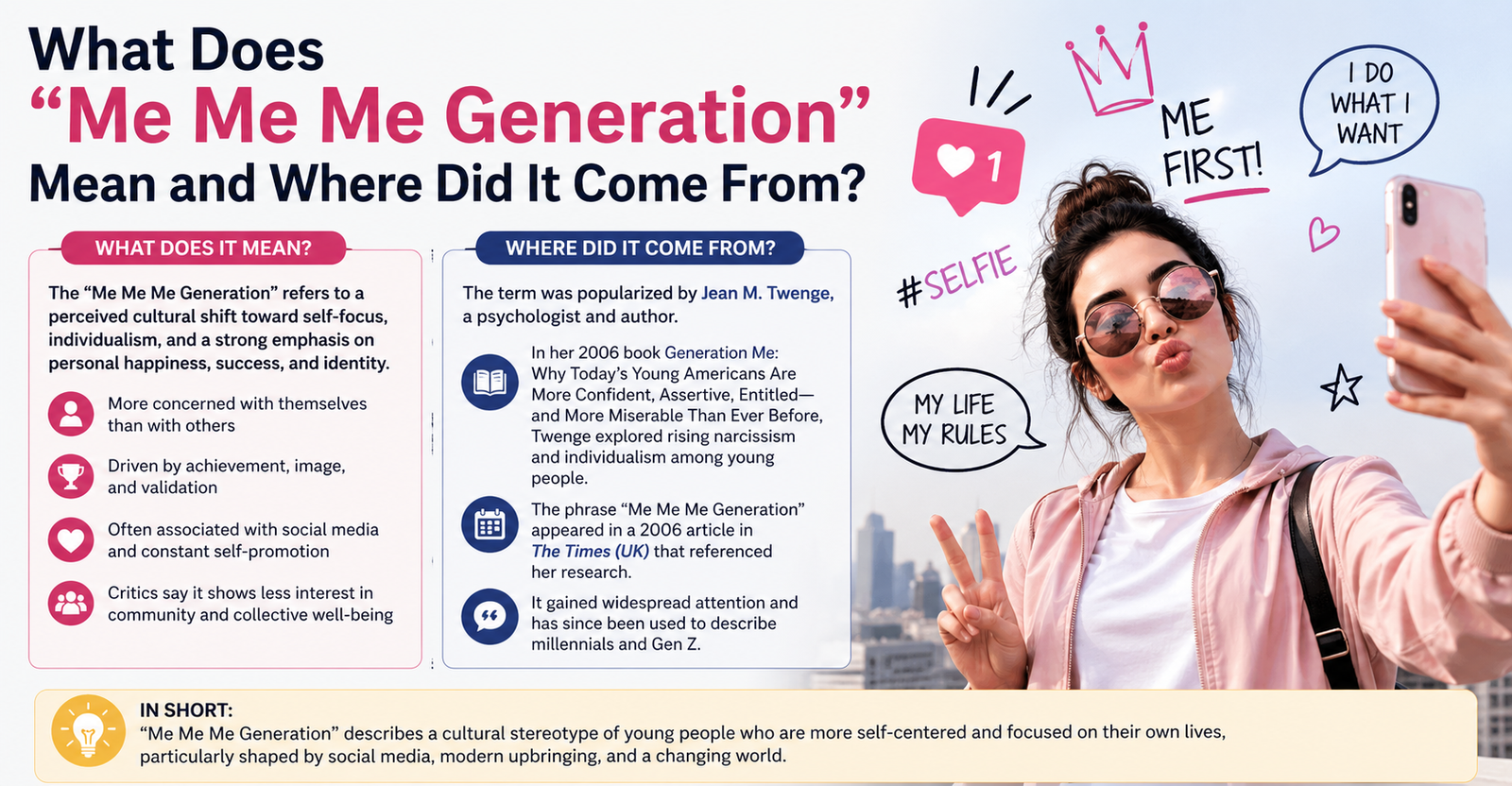
If you have searched the phrase “me me me generation,” you have probably noticed that it almost always leads back to Millennials. That is not an accident. The phrase became widely known after TIME ran Joel Stein’s 2013 cover story, “Millennials: The Me Me Me Generation.” But the idea behind it did not start there. It came out of a much older pattern in American culture, where younger people get described as self-absorbed, overly emotional, and too focused on themselves.
So when people ask what “me me me generation” means, the short answer is this: it is a label used to describe a generation seen as especially focused on the self, on personal identity, and on individual validation. In modern use, it usually points to Millennials. Historically, though, it connects to the older phrase “Me Generation,” which was originally used for Baby Boomers in the 1970s.
The reason the phrase stuck so strongly is simple. TIME gave it a huge stage. In May 2013, Joel Stein published a cover story that described Millennials as lazy, entitled, narcissistic, fame-obsessed, and deeply shaped by digital life. The piece pointed to things like higher narcissism scores, participation trophy culture, delayed adulthood, and the growing power of social media. At the same time, the article also made a more complicated argument: that this same generation might end up reshaping the world in meaningful ways. Even the subtitle, “Why millennials will save us all,” shows that the article was not just a one-note insult.
That matters because many people remember only the insult and forget the full framing. The phrase “me me me generation” became popular because it sounded sharp, funny, and provocative. It worked as a headline. But it also captured a real cultural anxiety from the early 2010s, when Facebook, Twitter, YouTube, selfies, online personal branding, and constant self-documentation were becoming a much bigger part of everyday life.
Long before Millennials were called the “me me me generation,” Baby Boomers were being called the “Me Generation.” That older label grew out of the 1970s, a period that writer Tom Wolfe famously called the “Me Decade.” The phrase reflected a cultural shift toward self-realization, self-fulfillment, and a more inward-looking kind of individualism. Around the same time, Christopher Lasch wrote about what he saw as a growing culture of narcissism in American life.
This is one of the most important things to understand if you want to explain the keyword properly. The phrase did not appear out of nowhere in 2013. TIME’s version was really a louder, updated version of an older accusation. First the culture said Baby Boomers were too focused on themselves. Then later it said the same thing about Generation X in different language. Then it said it again about Millennials. That repetition is part of the story.
Even though the criticism was older, Millennials were a perfect target for a stronger version of it. They came of age in the middle of the internet boom, the smartphone era, and the rise of public online identity. For older critics, this made them look unusually self-focused. Posting photos, sharing opinions, tracking likes, building personal brands, and curating an online image all seemed to confirm the stereotype. In that environment, “me” became “me me me.”
But that is only one side of it. A lot of what looked like narcissism to older generations also reflected changing technology and changing economic conditions. Millennials were entering adulthood during the aftermath of the Great Recession, dealing with unstable work, rising costs, delayed milestones, and a culture that pushed constant visibility. In other words, some of the behavior critics mocked was not just vanity. It was adaptation. If jobs, relationships, networking, and public identity were all happening online, then self-presentation stopped being optional.
That is why the phrase still gets attention. It is not only about whether one generation was selfish. It is about what changes when a culture starts rewarding visibility, performance, self-expression, and personal branding more than older forms of privacy or restraint.
This is where the topic gets more interesting. The phrase caught on because it sounded true to a lot of people. But researchers and commentators quickly pushed back on the idea that Millennials were uniquely narcissistic. An article highlighted by the Association for Psychological Science pointed to a 2010 paper by Brent W. Roberts, Grant Edmonds, and Emily Grijalva titled “It Is Developmental Me, Not Generation Me.” Their argument was that once newer data were added, there was no real long-term rise in narcissism among college students. More importantly, they argued that age-related changes were much larger than generational ones. In plain language, younger people may often seem more self-focused simply because they are young, not because their generation is uniquely broken.
That pushback changes the meaning of the phrase. Instead of seeing “me me me generation” as a settled truth about Millennials, it makes more sense to see it as a cultural label, one shaped by media, timing, and stereotype. It may describe a mood. It may describe a perception. But it is not the final word on an entire generation.
One reason the phrase keeps surviving is that it fits a very old social habit. Older adults often look at younger adults and see impatience, vanity, and self-absorption. Then, a few decades later, the target changes. A piece from 1517 makes this point in its own way by noting that accusations of self-centeredness have stretched across generations, from the era of Baby Boomers to Generation X and beyond. The wording changes, but the complaint stays familiar.
That does not mean the criticism is always meaningless. Every generation really is shaped by different tools, incentives, and social pressures. The internet did change how identity gets performed. Social media did make public self-display more normal. But the broader pattern is still worth noticing. The label says as much about the people using it as it does about the people being labeled.
Today, when someone uses “me me me generation,” they are usually referring to a stereotype, not a technical social science category. The phrase suggests narcissism, entitlement, self-promotion, status anxiety, social media obsession, personal branding, and a culture built around the visible self. Those ideas are what give the phrase its emotional force.
At the same time, the phrase also carries a built-in argument. It asks whether modern self-focus is a moral failure, a developmental stage, or just a normal response to a world that rewards constant exposure. That is why the term keeps getting searched. People are not only trying to define it. They are trying to figure out whether it was ever true in the first place.
The cleanest answer is this: the phrase became famous through TIME and Joel Stein’s 2013 portrait of Millennials, but its roots go back to the older “Me Generation” label used for Baby Boomers in the 1970s. That earlier language was shaped by Tom Wolfe’s idea of the “Me Decade” and by Christopher Lasch’s criticism of a growing culture of narcissism. By the time the internet age arrived, the old “me” label had simply been updated into a louder form that matched the era of selfies, social media, and public identity.