
 By Admin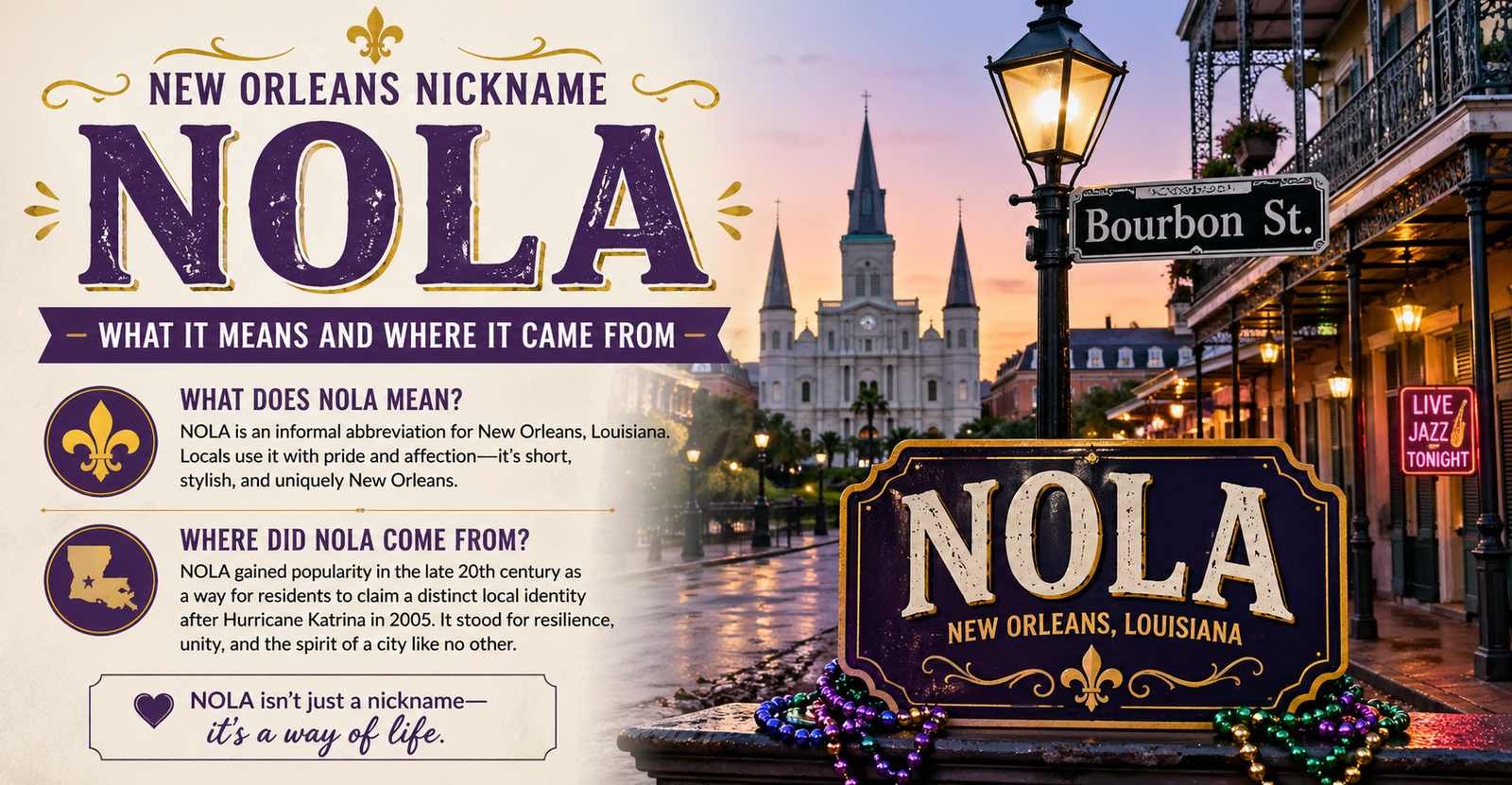
The New Orleans nickname NOLA is one of the most recognizable city nicknames in the United States. You see it on T-shirts, travel guides, restaurant names, social media captions, airport signs, local brands, and souvenirs all over the French Quarter. For many visitors, NOLA feels like a fun and easy way to talk about New Orleans.
But the nickname has more layers than it first appears.
At its simplest, NOLA means New Orleans, Louisiana. The first two letters come from New Orleans, and the last two letters come from LA, the abbreviation for Louisiana. Put them together, and you get NOLA.
That part is easy. The deeper story is about how the word became popular, why businesses and tourists use it so often, and why some New Orleanians feel differently about hearing it said out loud.
NOLA stands for New Orleans, Louisiana.
The nickname is formed from:
NO for New Orleans
LA for Louisiana
Together, those letters create NOLA, a short and catchy way to refer to the city.
It is not hard to understand why the nickname spread. New Orleans is a long city name, and NOLA is quick, memorable, and easy to fit into headlines, business names, hashtags, logos, and travel content. It also has a sound that feels musical, which fits a city known around the world for jazz, brass bands, Mardi Gras, Creole cuisine, and street culture.
Still, NOLA is not just a simple abbreviation anymore. Over time, it has become a cultural label, a tourism brand, and sometimes a point of debate.
No, NOLA is not the official name of the city. The official name is New Orleans, located in Louisiana, within Orleans Parish.
NOLA is an unofficial nickname and shorthand. It is widely understood, especially in writing, online searches, local business names, and tourism marketing. But official documents, city government pages, maps, and formal writing usually use New Orleans.
That does not make NOLA wrong. It simply means the word belongs more to casual language, branding, and culture than to official naming.
You might see NOLA used in:
Business names
Restaurant names
Travel blogs
Social media posts
Local news headlines
Merchandise
Event branding
Email addresses
Tourism marketing
Hashtags
For example, names like NOLA.com, NOLA Records, and Emeril’s NOLA helped make the term more familiar long before it became common in social media captions.
The origin of NOLA is mostly practical. It comes from combining the initials of New Orleans with the state abbreviation for Louisiana.
This style of naming is common in American city shorthand. People use abbreviations because they are easier to write, easier to brand, and easier to remember. In the case of New Orleans, NOLA also sounds smooth and distinctive, which helped it stick.
The nickname existed before the internet age, but its popularity grew over time. It appeared in music, media, restaurants, local businesses, and eventually online platforms. As the city became more visible in travel media and digital culture, NOLA became even more common.
After Hurricane Katrina, the term became more noticeable in national conversations about New Orleans, recovery, culture, rebuilding, and identity. More people outside the city began using NOLA in articles, campaigns, fundraisers, and travel content. That helped the nickname spread, but it also made the word more complicated for some locals.
The nickname NOLA became popular because it is short, easy to remember, and strongly tied to the city’s image.
For visitors, NOLA feels lively. It suggests music, food, festivals, nightlife, and Southern charm. It fits neatly on souvenirs and signs. It works well in phrases like NOLA food, NOLA music, NOLA weekend, NOLA wedding, or NOLA travel guide.
For businesses, it is useful branding. A company can put NOLA in a name and instantly signal a connection to New Orleans culture. Restaurants, tour companies, boutiques, hotels, musicians, and event organizers use it because the word carries a clear local flavor.
For online searches, it is convenient. People searching for NOLA hotels, NOLA restaurants, NOLA events, or NOLA Mardi Gras usually mean New Orleans, and search engines understand that connection.
The word also spread through:
French Quarter souvenir shops
T-shirts and magnets
Travel websites
Local media
Food tours
Music festivals
Wedding planning sites
Tourism campaigns
Instagram captions
Restaurant branding
In short, NOLA became popular because it is easy to say, easy to sell, and easy to recognize.
This is where the topic gets more interesting.
Some New Orleanians do say NOLA, especially in writing, texting, business names, or casual online use. Others rarely say it out loud and may prefer New Orleans. Some locals strongly dislike hearing the city called NOLA, especially when it feels forced, touristy, or disconnected from local culture.
So the honest answer is: yes, some locals use NOLA, but not everyone does.
For many people who grew up in New Orleans, the full name carries more feeling. New Orleans is not just a destination. It is home, memory, family, neighborhood, food, music, history, and community. To them, NOLA can sometimes sound like a marketing label rather than the name of a living city.
That does not mean visitors should panic about using the word. It simply means the nickname has different meanings depending on who is using it, where it is used, and how it is said.
Some locals dislike NOLA because it can feel too polished, too branded, or too closely tied to tourism. To them, the word may sound like something made for souvenirs rather than everyday local speech.
There is also a deeper cultural reason. New Orleans has gone through major changes, especially after Hurricane Katrina. The city has faced rebuilding, displacement, rising housing costs, neighborhood change, and debates about gentrification. In that context, language matters.
When some locals hear NOLA, they may associate it with:
Tourism marketing
Transplants
Post-Katrina change
Gentrification
Souvenir culture
Outside branding
Social media trends
Commercial versions of local culture
The concern is not only about four letters. It is about who gets to define the city.
For lifelong residents, New Orleans identity can feel deeply personal. The city’s culture comes from generations of Creole, Black, French, Spanish, Caribbean, African, and Southern influences. It is shaped by neighborhood traditions, family histories, foodways, music, festivals, and local speech.
When the city is reduced to a catchy nickname, some people feel that something gets lost.
Technically, NOLA and New Orleans refer to the same place. Emotionally, they can feel different.
New Orleans is the city’s real name. It feels fuller, older, and more rooted. It connects to Orleans Parish, the Mississippi River, the French Quarter, Tremé, Garden District, Marigny, Bywater, Uptown, Mid-City, and the many neighborhoods that make the city what it is.
NOLA is shorthand. It is useful, catchy, and widely recognized. It works well in branding, online searches, and casual writing. But for some people, it feels less personal than New Orleans.
A simple way to think about it is this:
NOLA is a nickname.
New Orleans is the place.
Both can be correct, but they do not always carry the same feeling.
Visitors can use NOLA, but it helps to understand the context.
If you are writing a search, using a hashtag, buying a souvenir, or reading a travel guide, NOLA is completely understandable. People will know what you mean.
If you are speaking with locals, especially in a respectful or serious conversation, New Orleans is usually the safer choice. It sounds more natural and less touristy.
For example, instead of saying, “I love how NOLA feels,” you might say, “I love New Orleans.” That small shift can sound more genuine.
There is no need to overthink every sentence. Just remember that New Orleans has a strong local identity, and many residents care deeply about how the city is represented.
The New Orleans nickname NOLA is popular, but it is not the only nickname connected to the city. New Orleans has collected many names over the years, each one reflecting a different side of the city.
The Big Easy is probably the most famous nickname for New Orleans after NOLA. It suggests a relaxed lifestyle, live music, nightlife, and a city that moves at its own rhythm.
The exact origin is debated, but the nickname is often linked to the city’s music scene, easygoing atmosphere, and reputation as a place where musicians could find work. Today, The Big Easy is used in travel writing, movies, tourism, and local storytelling.
Crescent City comes from the shape of the Mississippi River as it curves around New Orleans. From above, the river forms a crescent-like bend near the city.
This nickname feels more historic and geographic than NOLA. It points to the city’s relationship with the river, which has shaped its trade, architecture, neighborhoods, and culture for centuries.
New Orleans is widely known as the Birthplace of Jazz. The city’s music history is one of its greatest cultural contributions to the world.
Names like Louis Armstrong, Buddy Bolden, brass bands, second-line parades, and clubs on Frenchmen Street all connect to this identity. Even today, music is not just entertainment in New Orleans. It is part of daily life, celebration, mourning, and community tradition.
Mardi Gras is one of the biggest reasons people around the world know New Orleans. The city’s Carnival season includes parades, costumes, krewes, beads, king cake, music, and neighborhood traditions.
Calling New Orleans the Mardi Gras City highlights its festival spirit, but locals know the city is much more than one celebration.
The City That Care Forgot is an older nickname that points to the city’s relaxed, pleasure-loving image. It suggests a place where people come to eat, dance, listen to music, and forget their worries.
Like many nicknames, it captures one side of the city but not the whole story. New Orleans also has hardship, resilience, deep community ties, and a complicated history.
The Creole City reflects the city’s layered cultural roots. Creole culture in New Orleans is connected to food, language, architecture, music, family history, and identity.
This nickname reminds readers that New Orleans is not just a party destination. It is a city built from many cultures meeting, blending, and shaping something unique.
The nickname NOLA often appears beside the things visitors love most about the city.
You might see it used with gumbo, jambalaya, crawfish, beignets, po’boys, seafood, and Creole cuisine. You might also see it tied to jazz, brass bands, second-line culture, Mardi Gras, Jazz Fest, and street music.
That connection makes sense. New Orleans culture is one of the city’s biggest gifts to the world. The food is distinct. The music is instantly recognizable. The architecture feels different from many other American cities. The festivals have their own rhythm.
But it is important to remember that these things are not just tourist attractions. They come from real communities, histories, and traditions. NOLA may be the nickname on the sign, but New Orleans is the culture behind it.
The name New Orleans has a long history. The city was founded in the early 18th century and named for Philippe II, Duke of Orléans. Over time, it became one of the most culturally distinctive cities in the United States.
Its identity has been shaped by the Mississippi River, the Gulf Coast, colonial history, slavery, immigration, music, religion, food, language, and neighborhood life. The city’s name carries all of that.
That is why some locals prefer the full name. New Orleans feels layered. NOLA feels shorter, lighter, and more modern. Neither version is meaningless, but they do different work.
Yes, NOLA is a good nickname in the sense that it is memorable, widely understood, and closely tied to the city. It has become part of modern New Orleans branding and is useful in writing, travel, and business.
But it is also a nickname that should be used with a little awareness.
If you are writing a travel article, naming an event, or using a hashtag, NOLA can work well. If you are talking about the city’s people, history, struggles, or local identity, New Orleans may feel more respectful and complete.
The best approach is not to avoid NOLA completely. It is to understand that the word carries both popularity and sensitivity.
The New Orleans nickname NOLA comes from New Orleans, Louisiana. It combines NO from New Orleans with LA from Louisiana, creating a short and recognizable nickname for one of America’s most iconic cities.
Over time, NOLA became common in travel, branding, media, merchandise, restaurants, and online searches. It is easy to remember and strongly connected to the city’s image.
But NOLA is not just a cute abbreviation. For some New Orleanians, the word feels tied to tourism, post-Katrina change, transplants, and the commercialization of local culture. Others use it casually and do not mind it at all.
So, what is the best way to understand it? NOLA is a popular nickname, but New Orleans is the name with deeper roots. Both point to the same city, but they do not always feel the same.
If you are a visitor, it is fine to know and use NOLA, especially in writing or travel searches. But when you want to speak with care, respect, and a little local awareness, New Orleans is always the stronger choice.