
 By Admin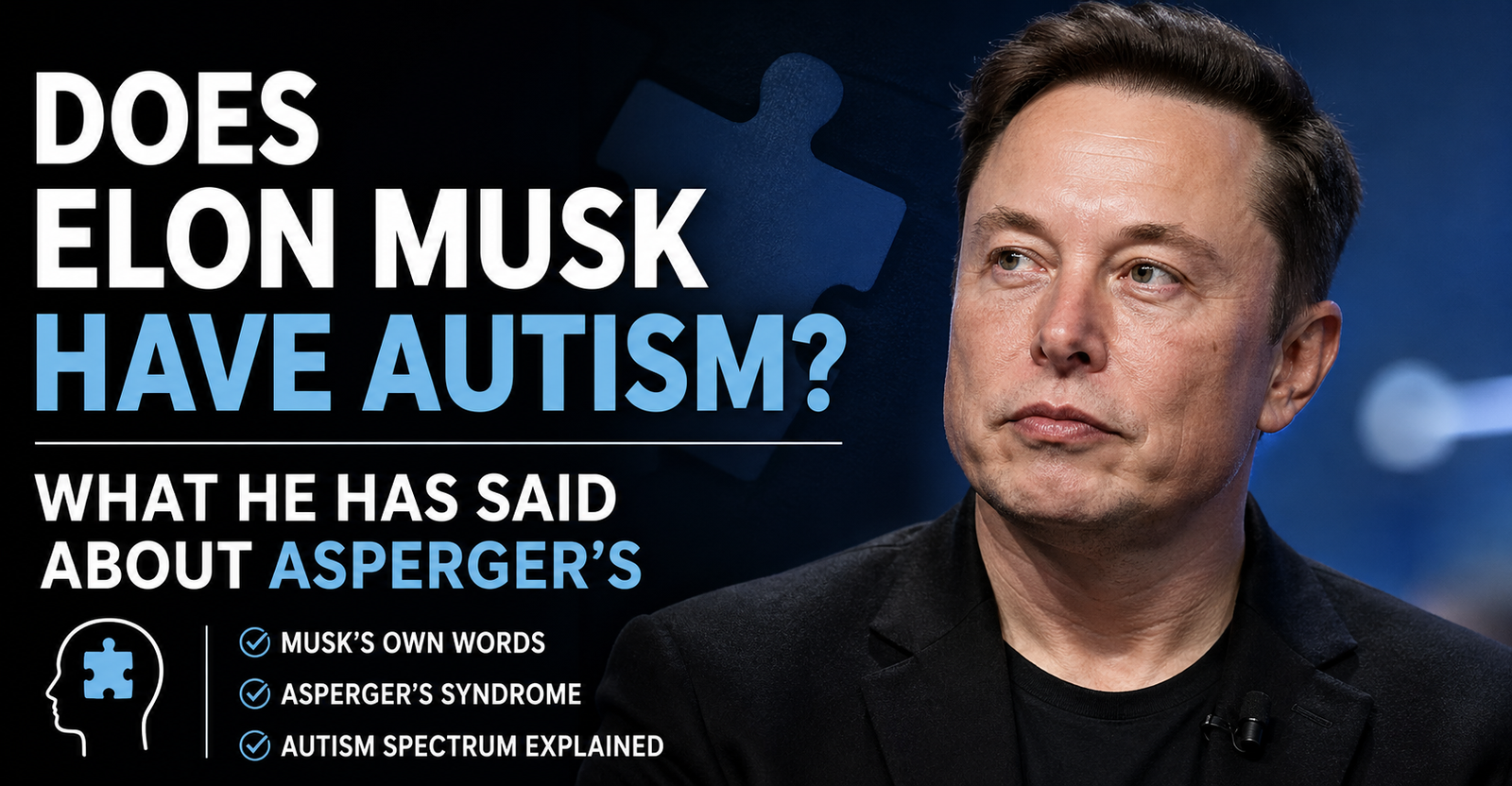
Many people search “does Elon Musk have autism” or “does Elon Musk have autistic” because they have heard clips, comments, or online discussions about Elon Musk and Asperger’s syndrome. The topic gets a lot of attention because Musk is one of the most visible technology figures in the world, and anything he says about his personal life quickly becomes part of public conversation.
The clear answer is this: Elon Musk has publicly said that he has Asperger’s syndrome. Today, Asperger’s syndrome is generally understood as part of autism spectrum disorder, often shortened to ASD.
That does not mean people should guess about his personality, behavior, or private medical history. The best way to talk about this topic is to focus on what Elon Musk has said himself, explain what Asperger’s means, and avoid turning the conversation into online diagnosis.
Yes, Elon Musk has publicly stated that he has Asperger’s syndrome. Since Asperger’s is now commonly included under the broader category of autism spectrum disorder, it is fair to say that he has publicly identified with a condition on the autism spectrum.
Still, there is an important difference between repeating someone’s own public statement and diagnosing them from the outside. Elon Musk made the statement himself, so the safest wording is:
Elon Musk has publicly said he has Asperger’s syndrome.
That keeps the answer accurate and respectful.
The most widely known moment came when Elon Musk hosted Saturday Night Live, also known as SNL, in 2021.
During his opening monologue, he said he was the first person with Asperger’s to host the show, then joked that he was at least the first to admit it. That line quickly spread across social media and news outlets because it was one of the first times many people heard Musk speak publicly about being on the autism spectrum.
The moment mattered for a few reasons.
First, SNL is a huge public stage. When someone as famous as Elon Musk talks about Asperger’s syndrome there, millions of people hear it.
Second, autism is often misunderstood. Some people still have outdated ideas about what autism or Asperger’s looks like. A public figure saying it openly can make more people curious about what the diagnosis actually means.
Third, the statement became part of the larger conversation around neurodiversity, technology, communication styles, and public life.
After the SNL appearance, Elon Musk also spoke about growing up with Asperger’s during a public interview at TED2022 in Vancouver.
He talked about how social cues were not always intuitive for him. That is a common experience for many people on the autism spectrum, though every autistic person is different. Some people may struggle with reading facial expressions, tone, indirect language, or unspoken social rules. Others may not have the same challenges, or they may have learned ways to adapt over time.
Musk also suggested that his way of thinking may have helped him in technology-related work. This is another reason the topic gets attention. People often connect Elon Musk with intense focus, engineering, innovation, and problem-solving because of his work with Tesla, SpaceX, Neuralink, The Boring Company, and X.
However, it is important not to reduce autism to a “genius trait.” Autism spectrum disorder can include strengths and challenges. It is not a simple explanation for success, and it should not be turned into a stereotype.
This is one of the biggest sources of confusion.
Asperger’s syndrome used to be treated as a separate diagnosis. It was often used for people who had autism-related social and communication differences but did not have major language delays or intellectual disability.
Today, modern diagnostic language generally places Asperger’s syndrome under autism spectrum disorder. That means many people who were once diagnosed with Asperger’s are now described as being on the autism spectrum.
So when someone asks, “Does Elon Musk have Asperger’s or autism?” the answer is that Musk has publicly said he has Asperger’s, and Asperger’s is now commonly understood as part of ASD.
Some people still use the word Asperger’s because it was the diagnosis they received, or because it feels familiar to them. Others prefer the broader term autistic or person on the autism spectrum. Language varies from person to person.
There are several reasons people keep asking whether Elon Musk is autistic.
One reason is his own public statement. Once he mentioned Asperger’s syndrome on SNL, the topic became part of his public profile.
Another reason is his communication style. Musk is known for direct comments, unusual jokes, blunt interviews, and a public persona that does not always match traditional CEO behavior. Some people connect those traits to autism, but that can become risky if it turns into armchair diagnosis.
A third reason is public curiosity about famous people and mental health or neurodevelopmental conditions. People often search whether celebrities, entrepreneurs, actors, or scientists are neurodivergent because they want to understand how different thinking styles may shape success.
That curiosity is understandable, but it should be handled carefully. A public figure’s diagnosis should not become an excuse for mockery, assumptions, or stereotypes.
The phrase “does Elon Musk have autistic” is not the most natural wording. A better way to ask the question is:
Does Elon Musk have autism?
Is Elon Musk autistic?
Does Elon Musk have Asperger’s syndrome?
When writing about autism, respectful language matters. Some people prefer identity-first language, such as autistic person. Others prefer person-first language, such as person with autism. There is no single phrase that every person likes.
The safest approach is to avoid using autistic as an insult or as a casual label for someone’s behavior. Autism is a real neurodevelopmental condition, not a punchline.
It is also better to avoid saying things like “suffers from autism” unless the person uses that language for themselves. Many autistic people do not see autism only as suffering. They may see it as part of how they think, communicate, process the world, and experience life.
Autism spectrum disorder is a developmental condition that can affect communication, social interaction, sensory processing, routines, interests, and behavior. The word “spectrum” matters because autism does not look the same in every person.
Some autistic people need daily support. Others live independently, run companies, build careers, raise families, and may not appear obviously different to people around them. Some are highly verbal. Others are non-speaking. Some enjoy social situations but find them exhausting. Others prefer less social contact.
Common areas connected with ASD can include:
Social communication differences
Difficulty reading certain social cues
Strong focus on specific interests
Sensory sensitivities
Preference for routine
Literal thinking
Repetitive behaviors
Executive functioning challenges
Masking in social settings
Not every autistic person has all of these traits. That is why it is important not to judge someone’s diagnosis based only on a few public behaviors.
Because Elon Musk is so visible, his comments about Asperger’s have shaped public conversation in both helpful and complicated ways.
On one hand, his openness brought more attention to autism spectrum disorder and neurodiversity. For some people, seeing a famous entrepreneur speak about Asperger’s may reduce stigma or make them feel less alone.
On the other hand, not everyone in the autistic community feels represented by Musk. Some people dislike the way media conversations use him as an example of autism, especially because public views of him are strongly divided. Others worry that focusing on billionaire success stories can create unrealistic ideas about autistic people.
Both reactions can exist at the same time. One person’s public story does not represent every autistic person.
It would be too simple to say autism explains Elon Musk’s success.
Musk has built or led major companies, including Tesla, SpaceX, X, Neuralink, and The Boring Company. His career involves engineering, finance, leadership, risk-taking, product strategy, and public communication. Many factors shaped that career, including opportunity, ambition, resources, timing, business decisions, and personal traits.
His Asperger’s may be part of how he thinks and communicates, based on what he has said. But it should not be treated as the single reason for his achievements.
Autistic people are not all tech geniuses. They are not all socially awkward in the same way. They are not all math-focused, emotionless, or isolated. Those stereotypes can be harmful.
A better way to frame it is this: Elon Musk has said he has Asperger’s, and his experience adds one public example to a much broader conversation about neurodiversity.
After Musk’s public comments, many people began analyzing his interviews, tweets, facial expressions, jokes, and behavior. Some of that discussion is harmless curiosity. But it can cross a line when people start using autism as an insult or trying to diagnose every public action.
Online speculation can be harmful because it turns a real condition into gossip. It can also spread false ideas about autism.
For example, someone may say, “He is blunt, so that proves autism.” That is not how diagnosis works. A real autism diagnosis is based on a detailed clinical process, not one behavior or a few video clips.
In Elon Musk’s case, the public answer comes from his own statement, not from outside guesses.
The discussion around Elon Musk and Asperger’s syndrome is part of a larger conversation about neurodiversity.
Neurodiversity is the idea that people’s brains work in different ways, and those differences should not automatically be seen as defects. This can include autism, ADHD, dyslexia, and other forms of neurodivergence.
That does not mean every challenge disappears. Many autistic people face real difficulties with sensory overload, communication, employment, healthcare, education, anxiety, and social expectations. But the neurodiversity view reminds people that different ways of thinking can also bring strengths.
For some autistic people, strengths may include deep focus, pattern recognition, honesty, technical thinking, memory, creativity, or persistence. For others, strengths may show up in completely different ways.
The key is to see autistic people as full human beings, not stereotypes.
When a famous person shares that they are autistic or have Asperger’s, it can change public awareness. But disclosure is personal.
Some public figures choose to talk openly about diagnosis. Others keep medical and identity-related information private. Both choices deserve respect.
In Elon Musk’s case, he chose to talk about Asperger’s syndrome publicly. That makes it fair to discuss his own words. But it is still important to avoid digging beyond what he has shared or using autism as a way to explain every part of his personality.
Public figures are complex. So are autistic people.
If someone asks, “Does Elon Musk have autism?”, the best answer is:
Elon Musk has publicly said he has Asperger’s syndrome, and Asperger’s is now generally considered part of autism spectrum disorder.
That answer is accurate, clear, and respectful.
If someone asks, “Is Elon Musk autistic?”, you can say:
Based on his own public comments about Asperger’s, he has identified with a condition on the autism spectrum.
That avoids pretending to know more than what he has personally shared.
Elon Musk has publicly said he has Asperger’s syndrome, most notably during his Saturday Night Live appearance in 2021. Since Asperger’s is now commonly understood as part of autism spectrum disorder, many people describe him as being on the autism spectrum.
The topic should be handled with care. It is fine to discuss Musk’s public statements, but it is not helpful to diagnose him from interviews, social media posts, or personality traits. It is also important not to use autism or Asperger’s as a joke, insult, or simple explanation for someone’s behavior.
The most respectful answer is also the clearest one: Elon Musk has said he has Asperger’s syndrome, and today that is generally included under autism spectrum disorder.