
 By Admin
A college baseball game usually lasts around 2.5 to 3 hours, but the exact time can change a lot from one game to another. Some games move quickly and finish in about 2 hours and 30 minutes, while others can stretch past 3.5 hours if there are long innings, pitching changes, extra innings, weather delays, or a lot of scoring. Several college baseball guides give the same general range of about 2.5 to 3 hours for a typical game.
The simple answer is this: most NCAA baseball games are scheduled for nine innings, but baseball does not run on a game clock. The final length depends on how fast the innings move. A clean, low-scoring game with strong pitching can finish quickly. A game full of walks, mound visits, pitching changes, errors, and rallies can take much longer.
That is why the best answer to how long does a college baseball game last is not just “three hours.” It is usually about three hours, but fans should plan for a little more time if the game is close, televised, high-scoring, or affected by weather.
A standard college baseball game is built around nine innings, just like Major League Baseball. The NCAA rule book says a regulation game is nine innings unless it is extended because of a tie, shortened under approved rules, or scheduled differently as part of a doubleheader.
Each inning gives both teams a chance to bat. The visiting team bats in the top half of the inning, and the home team bats in the bottom half. If the home team is already winning after the top of the ninth inning, the bottom half of the ninth is not played because the home team does not need another turn at bat.
This inning structure is the main reason baseball feels different from timed sports like football or basketball. There is no countdown clock. The game ends when the required outs are recorded, not when a timer reaches zero.
Not every college baseball game reaches the three-hour mark. Some games move faster because both pitchers are throwing strikes, hitters are putting the ball in play early, and teams are avoiding long innings.
A shorter game often has:
Quick innings
Low pitch counts
Few walks
Limited mound visits
Few pitching changes
Clean defense
Low scoring
No replay delays
A classic pitcher’s duel can fly by because there are fewer base runners and fewer stoppages. When pitchers work quickly and hitters avoid deep counts, the game has a natural rhythm.
The pitch clock also helps keep games moving. College baseball has added pace-of-play rules over the years, including a 20-second action clock. NCAA materials for the 2025 and 2026 rules cycle also mention changes to when the hitter must be alert and ready, moving that point from 10 seconds to 8 seconds remaining on the pitch clock.
A game can easily pass three hours if the pace slows down. Baseball has many natural pauses, and college games can become especially long when pitchers struggle with command or coaches use several relievers.
A longer game usually includes:
High pitch counts
Walks
Foul balls
Long at-bats
Big scoring innings
Multiple pitching changes
Mound visits
Errors
Replay reviews
Injury delays
Weather delays
Extra innings
One long inning can change the whole length of the game. If a team scores five runs in an inning and the opponent answers with a rally of its own, the game clock can grow quickly even if only one inning has passed.
This is why two college baseball games with the same nine-inning structure can feel completely different. One may finish in 2 hours and 35 minutes, while another may take nearly 4 hours.
Most college baseball games are nine innings, but seven-inning games can happen in certain doubleheader situations. The NCAA rule book allows doubleheaders to be scheduled in different formats, including two nine-inning games, two seven-inning games, or one seven-inning game and one nine-inning game. It also says a stand-alone scheduled seven-inning game is prohibited under NCAA rules.
This matters because many fans hear that college baseball games are always nine innings, then see a seven-inning game on a schedule and get confused. In most cases, that shorter format is connected to a doubleheader, weather rescheduling, or conference-approved scheduling rules.
A seven-inning game usually finishes faster than a nine-inning game, often closer to 2 hours if the pace is clean. But it can still run long if there are delays, lots of runs, or extra innings.
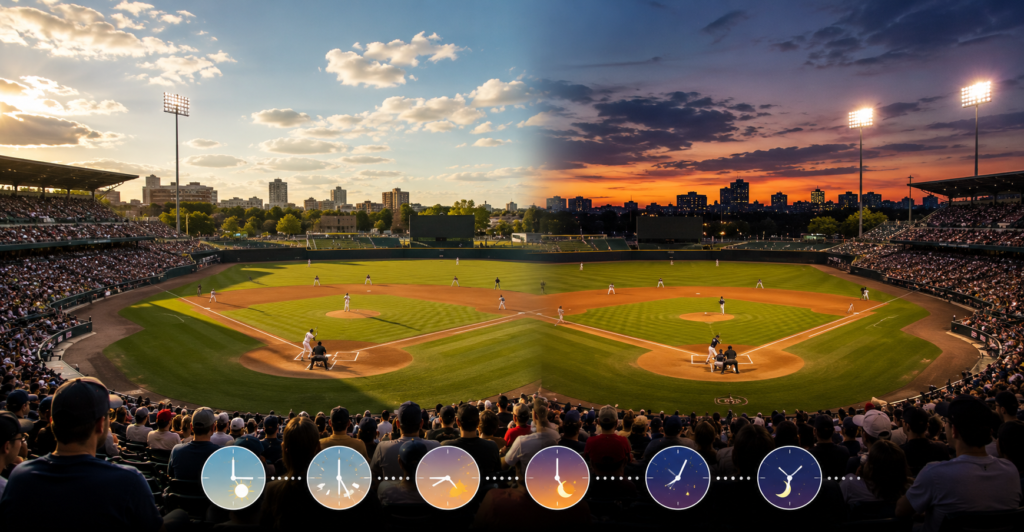
A doubleheader means two games are played on the same day between the same teams. In college baseball, doubleheaders are common because teams often play weekend series, and weather can force schedule changes.
If both games are seven innings, fans may still spend a long time at the ballpark because they are watching two separate games. A doubleheader can easily turn into a full afternoon or evening event.
For example:
A quick seven-inning game may take about 2 hours
A slower seven-inning game may take closer to 2.5 hours
Two seven-inning games together can take 4 to 5 hours with the break between games
Two nine-inning games can take much longer
The NCAA rules also note that doubleheader games should be played consecutively within a short window, which helps explain why doubleheader days are treated differently from normal single-game schedules.
If a college baseball game is tied after nine innings, it can go into extra innings. That means the game continues until one team has the lead after a completed inning.
Extra innings are one of the biggest reasons a game can run long. A game that is tied 4-4 after nine innings may finish in the 10th, or it could keep going for several more innings. Since baseball has no fixed ending time, a tied game can stretch well beyond the normal three-hour window.
The NCAA rule book says a regulation game can be extended because of a tied score. That means fans should always be ready for a longer day if the game is close late.
For first-time fans, this is an easy way to think about it: if the score is tied after nine innings, do not expect the game to end on time. It will continue until there is a winner, unless halted-game or conference rules come into play.
The pitch clock is one of the biggest pace-of-play tools in modern college baseball. It is designed to reduce dead time between pitches and keep the game moving.
The NCAA’s 2026 Baseball Clock Operation Guide discusses the 20-second action clock and between-innings time limits. It says the 20-second time limit begins when the ball is dead and all participants are ready under the clock protocol.
The 2025 and 2026 rules changes also mention that the hitter must be alert and ready with 8 seconds remaining on the pitch clock, a change from the previous 10-second requirement.
In simple terms, the pitch clock helps reduce unnecessary waiting. It does not guarantee every game will be short, but it helps prevent pitchers and hitters from taking too much time between pitches.
Still, the pitch clock cannot control everything. A game with 15 runs, 12 walks, and six pitching changes will still take longer than a clean 2-1 game.
Another reason some college baseball games end early is the run rule, often called the mercy rule. Under NCAA rules, by conference rule or by mutual consent before the game, a game may be stopped after seven innings if one team leads by at least 10 runs.
This rule helps prevent games from dragging on when the outcome is no longer competitive. It can also protect pitchers and reduce unnecessary innings in a lopsided game.
For example, if a team leads 13-2 after seven innings and the run rule applies, the game can end there instead of continuing to the full nine innings.
However, fans should remember that the run rule may depend on the competition, conference rule, or pre-game agreement. It should not be assumed in every single college baseball matchup.
Weather is one of the biggest unknowns in baseball. A game that should last three hours can turn into a much longer event if rain, lightning, or darkness interrupts play.
Common weather delays include:
Rain delays
Lightning delays
Field maintenance delays
Darkness at fields without lights
Suspended games
Halted games
College baseball often starts earlier in the year than many casual fans realize, so teams may deal with cold weather, rain, wind, and unpredictable field conditions. A rain delay can last 20 minutes, one hour, or even force the game to be completed later.
This is why fans attending in person should check the forecast and the school’s official athletics page before heading to the stadium.
A televised college baseball game can take longer than a non-televised game. Broadcasts often include commercial breaks, replay reviews, between-inning segments, and extra time for production.
Big games, especially during conference tournaments or the NCAA Tournament, may feel slower because there is more attention on every pitch, more camera coverage, and more replay discussion.
That does not mean every televised game becomes long, but fans should expect a slightly more controlled pace when a game is part of a major broadcast window.
College baseball and MLB are both usually based on nine innings, but the feel of the game can differ. College games often have more roster movement, more pitching changes, more errors, and sometimes more uneven scoring. Those factors can make some college games feel unpredictable in length.
MLB has its own pitch clock and pace-of-play system. The league added a 30-second timer between batters and pitch timers as part of its modern pace rules. College baseball has similar pace goals, but the exact rules and enforcement can vary by NCAA rule, conference policy, and game setting.
In general:
MLB games are nine innings and now often move faster than they did before the pitch clock
College baseball games are usually nine innings and often last around 2.5 to 3 hours
High school baseball games are usually shorter because they often last seven innings
For fans, college baseball sits in the middle. It is usually longer than high school baseball but can feel a little less predictable than MLB.
If you are going to a college baseball game, plan for about 3 hours. That is the safest expectation for a normal nine-inning game.
If you want to be more realistic, use this guide:
Fast game: about 2 hours 30 minutes
Typical game: about 3 hours
Slow or high-scoring game: about 3.5 hours
Extra-inning or delayed game: 4 hours or more
If you are attending a doubleheader, plan for much longer. Even two seven-inning games can take most of an afternoon once you include the break between games, warmups, and possible delays.
A college baseball game usually lasts around 2.5 to 3 hours. Most NCAA baseball games are scheduled for nine innings, but some doubleheader games can be seven innings. A game can be shorter because of the run rule, or longer because of extra innings, weather delays, pitching changes, high scoring, replay reviews, or broadcast breaks.The easiest rule for fans is simple: expect about three hours, but leave extra time if it is a close game or a big matchup. Baseball does not run by a clock, so the final out decides when the game really ends.