
 By Admin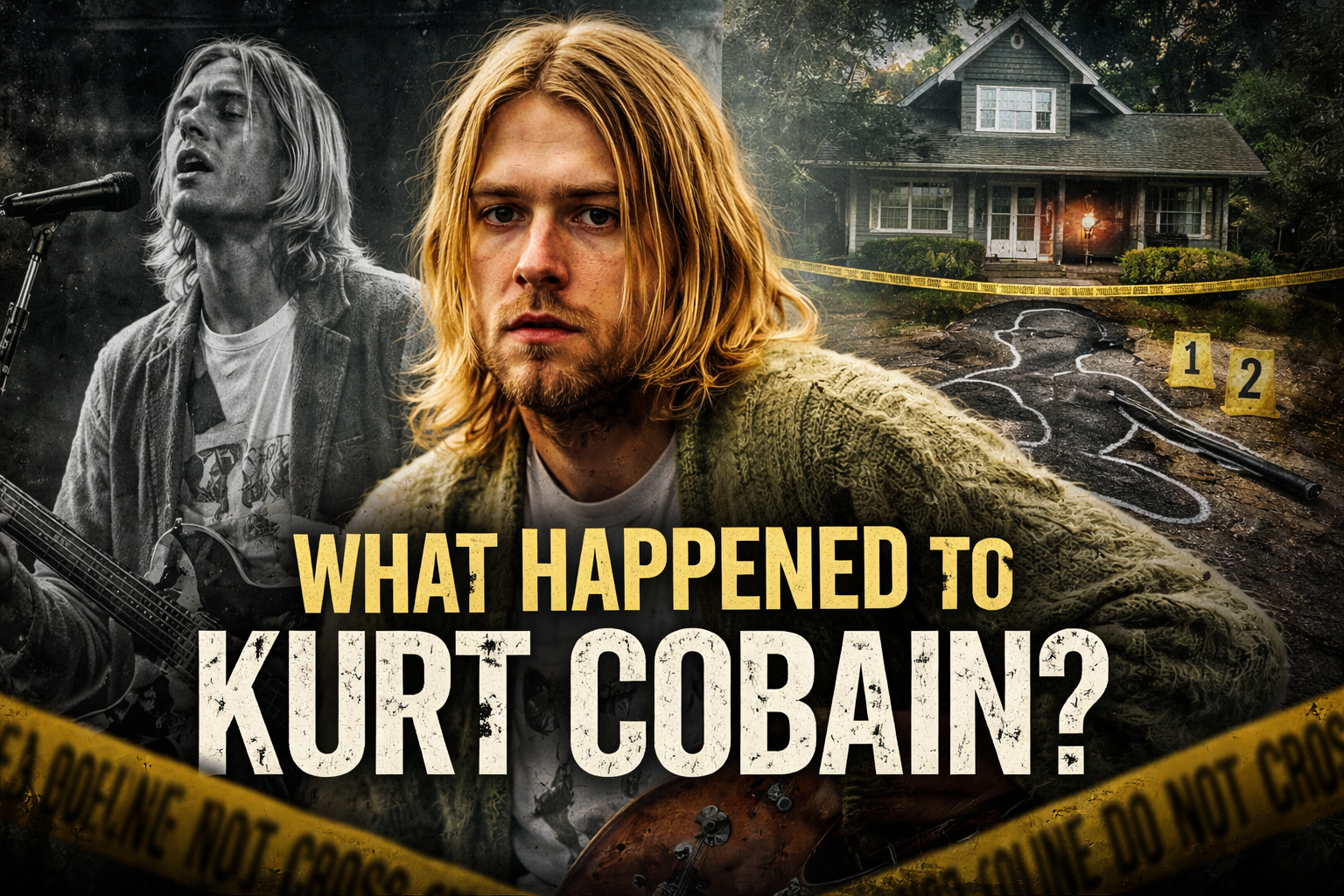
More than three decades later, people still ask what happened to Kurt Cobain. Part of that comes from the scale of his fame, and part of it comes from the way his life seemed to capture so much of the tension inside early 1990s rock culture. As the frontman of Nirvana, he became one of the defining voices of the grunge era, helping turn albums like Nevermind and In Utero into landmarks of modern music.
Kurt Cobain was born in Aberdeen, Washington, on February 20, 1967, and rose to international fame as the lead singer, guitarist, and primary songwriter of Nirvana. His music connected with listeners because it felt raw, honest, and emotionally exposed in a way that much of mainstream rock did not. That is a big part of why his death in 1994 still feels like a turning point in music history.
The basic timeline is clear. Kurt Cobain died on April 5, 1994, in Seattle, Washington, at the age of 27. His body was found three days later, on April 8, at the Seattle home he shared with Courtney Love. Reports from later coverage and anniversary retrospectives place the discovery in the greenhouse above the garage area of the property.
The death was ruled a suicide, and that official finding has not changed. In 2014, Seattle Police Department cold case detective Mike Ciesynski reviewed the file because of ongoing media attention and conspiracy theories. According to the department, he reviewed statements and evidence photos but did not reopen or reinvestigate the case, which remained closed. A more recent FOX 13 Seattle report said the department still has no plans to reopen it.
The weeks leading up to Cobain’s death were difficult. Recent coverage from People notes that he had long struggled with depression, substance abuse, chronic physical pain, and the pressure that came with sudden fame. In late March 1994, he briefly entered treatment at Exodus Recovery Center in California, then left shortly afterward. His disappearance added to the concern among the people closest to him.
That context matters because it helps explain why his death was felt as both shocking and heartbreakingly familiar to those who had followed his life closely. He had become a global star, but he also remained someone many people saw as deeply uneasy with celebrity, scrutiny, and the expectations placed on him. When the news broke, it did not feel like the death of a distant rock icon. For many fans, it felt painfully personal.
A major reason this story still circulates is that Cobain’s death became surrounded by years of public speculation. The official position has remained the same, but documentaries, books, television specials, and internet debates kept the case in public view. The Seattle Police Department acknowledged in its 2014 review that there had been many conspiracy theories and a high level of media interest, especially around major anniversaries.
That continued attention also explains why later photo releases generated headlines. Media outlets often framed those releases as new developments, but they did not change the case outcome. The police review reaffirmed the original conclusion rather than introducing a new one. So while interest around the case has never fully disappeared, the official record has remained consistent.
The public response to Kurt Cobain’s death was enormous. Fans mourned across Seattle and far beyond it, and the loss was widely seen as one of the defining cultural shocks of the 1990s. A Reuters report on the 30th anniversary showed how strongly that feeling still lingers, with fans traveling from around the world to visit key places tied to Cobain and Nirvana.
What stood out then, and still stands out now, is how many people felt they had lost someone who had given shape to their own feelings. Nirvana’s music spoke to frustration, alienation, tenderness, anger, and vulnerability all at once. That emotional connection is one reason people continue to revisit his story, not only because of how he died, but because of what he meant while he was alive.
It is impossible to talk about what happened to Kurt Cobain without also talking about what he left behind. As the face and voice of Nirvana, he helped move grunge from a regional sound in the Pacific Northwest into the center of global popular culture. Britannica identifies him as the lead singer, guitarist, and primary songwriter of one of the most important bands of the era, and later coverage continues to describe him as one of the defining musicians of his generation.
Albums like Nevermind, In Utero, and MTV Unplugged in New York still shape how people understand 1990s rock. His songwriting carried a sharp mix of melody, discomfort, sarcasm, and emotional honesty that remains instantly recognizable. That is why the conversation around Cobain has never been only about tragedy. It is also about influence, artistry, and the lasting power of the music he made.
People still search for Kurt Cobain because his story sits at the crossroads of fame, pain, and cultural memory. Some are discovering Nirvana for the first time. Others are revisiting the music they grew up with. And many are trying to understand how someone so influential could also be so visibly burdened. Anniversary coverage, documentaries, biographies, and online debate have all helped keep that curiosity alive.But the strongest reason his story endures is simpler than that. The music lasted. Even after all these years, Kurt Cobain remains central to how people talk about authenticity in rock music, the emotional reach of grunge, and the complicated cost of becoming a symbol for an entire generation. His death was a tragedy. His legacy, though, continues to live through the songs, the records, and the connection listeners still feel when they hear Nirvana.