
 By Admin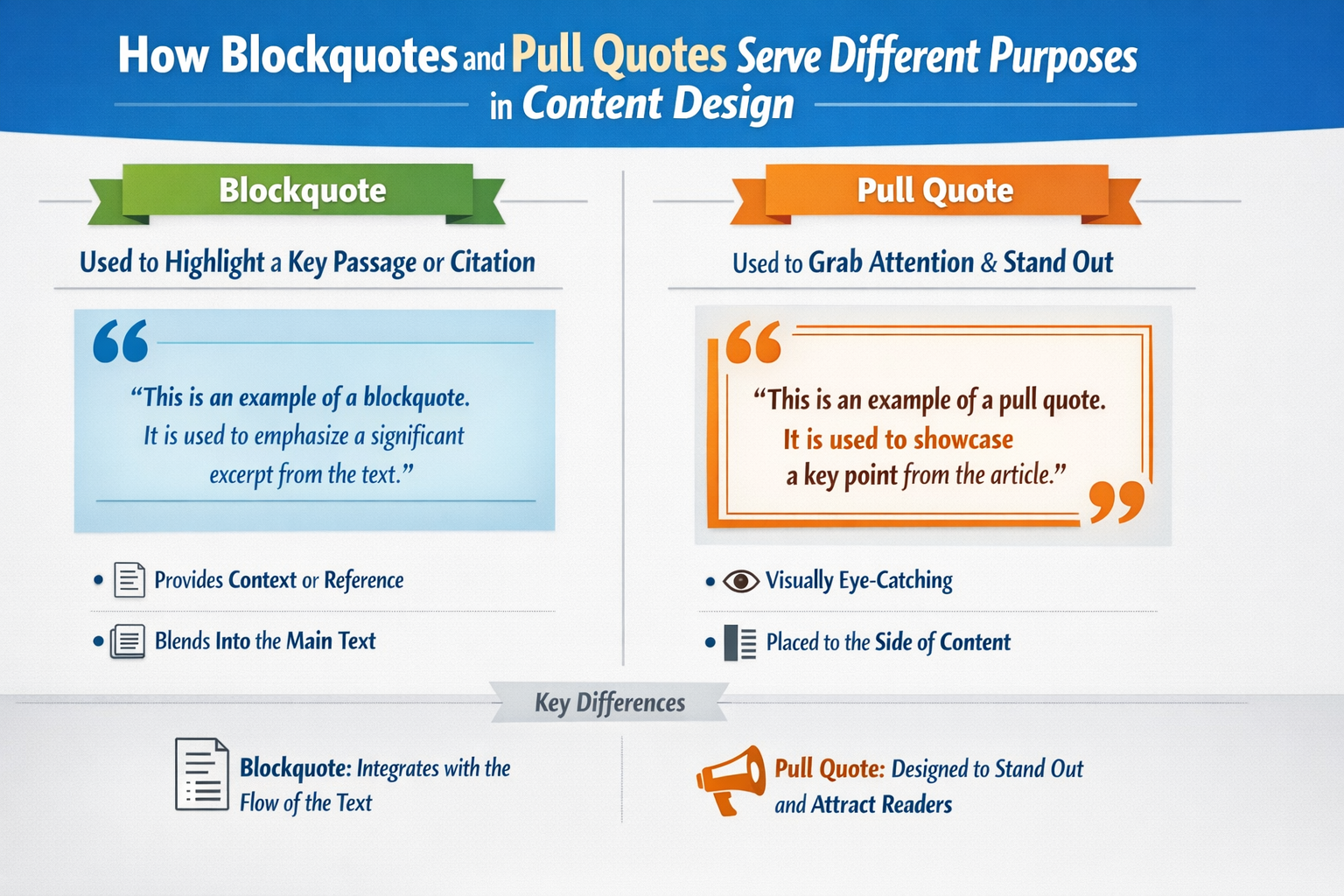
People often treat Blockquotes and pull quotes like they are basically the same thing. On the surface, that confusion makes sense. Both set text apart. Both can make a page more visually interesting. Both involve quoted language. But in actual content design, they do very different jobs. MDN describes the <blockquote> element as an extended quotation, while editorial and brand-guidance sources define a pull quote as an excerpt taken from the main body copy and styled to grab attention.
That difference matters more than it might seem. A blockquote helps with structure, attribution, and meaning inside the flow of an article. A pull quote helps with emphasis, pacing, and visual rhythm on the page. When those roles get mixed up, the design can feel sloppy and the reading experience gets weaker.
The confusion usually starts with appearance. A reader sees a chunk of text set apart from the surrounding paragraph and assumes it is all one category. But design is only one layer of the story. Notre Dame Creative points out that a blockquote is used to separate quoted text from the text around it, while a pull quote is duplicated from the article itself and displayed as an attention-grabbing visual element. Columbia makes a similar distinction, describing the pull quote as a graphic treatment and the block quote as an extended direct quotation, usually from an external source.
That is why the terms should not be used interchangeably. One is mainly about semantic meaning and citation. The other is mainly about visual emphasis.
A blockquote is there to present a quotation as part of the actual reading flow. In HTML, MDN says the <blockquote> element is for an extended quotation, usually displayed with indentation, and it can carry a cite attribute pointing to the source. Pressbooks and other publishing guides also describe blockquotes as stand-alone blocks for longer quotations, often used without quotation marks because the formatting itself signals that the text is quoted.
In practice, that means a blockquote supports the content rather than interrupting it. It can bring in an outside voice, preserve the wording of an interview, highlight a passage from a source, or let a reader sit with a statement that deserves more space than an inline quote. Even when the style changes from site to site, the purpose stays fairly stable. It is still part of the article, not a separate visual flourish.
A pull quote works differently. It is usually a short excerpt taken from the article itself and repeated somewhere on the page in a more eye-catching style. Columbia describes it as a graphic style created from the main body copy, often given a different size, format, or color to attract attention. WordPress documentation makes the same basic point in simpler terms, saying pullquotes are like blockquotes but designed to draw attention.
That design purpose changes how the reader experiences it. A pull quote is not there to add new evidence or introduce an external source. It is there to spotlight a line, create a pause, and pull the eye toward something memorable. In magazine design and long-form articles, that can be very effective. A well-chosen pull quote can tease an idea, sharpen the tone of the piece, or make a page feel less dense.
The cleanest way to understand the contrast is this: a blockquote supports structure, while a pull quote supports emphasis.
A blockquote helps the article say, “This wording comes from a source, and it belongs right here in the argument.” A pull quote helps the page say, “This line matters, so notice it.” Those are not small differences. They shape how a reader interprets both the text and the design around it. Smashing Magazine notes that pull quotes pull a passage out of the reader’s flow and give it a more dominant position, while block quotations stay within the flow and refer to outside citation.
This is why strong content design is not only about making things look good. It is also about matching the form to the job. The more clearly each element communicates its purpose, the easier the page is to trust and understand.
A blockquote makes more sense when the exact wording matters and the quotation genuinely belongs inside the body of the piece. That often happens in reported articles, essays, interviews, research summaries, case studies, and academic or institutional writing. Because blockquotes are associated with source-based quotation, they help preserve credibility and context. MDN also notes that source information can be attached through the cite attribute, which reinforces the role of the blockquote as a quotation element rather than just a design effect.
A blockquote also works better when the passage is a little longer and needs room to breathe. Trying to force that kind of quotation into a flashy visual callout can make it feel ornamental when it should feel integral. In content that depends on logic, evidence, or careful interpretation, the quieter treatment is often the stronger one.
A pull quote earns its place when the page needs a visual break and the article contains a line worth spotlighting. That might be a sharp insight, a revealing phrase, a surprising claim, or a sentence that captures the central mood of the piece. Columbia recommends keeping pull quotes simple, meaningful, short, and visually distinct. It also suggests creating enough distance from nearby headings, images, and other design elements so the page does not feel crowded.
That advice matters because a pull quote can easily become too much of a good thing. J. M. Elliott makes the point especially well by saying pull quotes stop readers in their tracks and can either guide or distract depending on placement. In other words, they are powerful, but they are not neutral. They change the rhythm of reading, so they need to be chosen and placed with care.
The problem with mixing them up is not just technical. It changes the reader’s expectations.
When a designer styles a blockquote like a dramatic pull quote, readers may mistake a source citation for a piece of promotional or decorative text. Notre Dame Creative explicitly warns that overly extreme blockquote styling can lead people to use blockquotes as if they were pull quotes, which blurs the meaning of the passage.
The opposite mistake is not great either. If a pull quote is treated like a plain quotation block, it loses the visual purpose that justifies repeating text in the first place. Then the page ends up with duplication but no real payoff. Good content design avoids both problems by giving each element a clear role.
This topic is not only about typography. It is also about usability. Smashing Magazine notes that pull quotes inserted into the middle of HTML content can create problems for plain-HTML views and screen readers, because the repeated text may appear to break the article flow in awkward ways. J. M. Elliott also points out that online pull quotes bring scaling and accessibility challenges, especially on mobile layouts and with assistive tools.
That does not mean pull quotes are a bad idea. It means they should be handled thoughtfully. The more decorative the treatment becomes, the more important it is to think about legibility, spacing, contrast, and how the excerpt behaves across different screens. Columbia also ties pull-quote styling to contrast and WCAG 2.2 AA accessibility standards, which is a useful reminder that visual emphasis should not come at the cost of readability.
A lot of confusion also comes from publishing tools. In some editors, the options sit next to each other and look like minor style variations. But even those systems still point to a difference in purpose. WordPress.org describes the pullquote block as a way to add emphasis to text and make short snippets stand out, while Boise State’s WordPress guide says the distinction between quote and pullquote is mostly formatting in the editor experience.
That practical detail is useful because it explains why the mix-up keeps happening. In a CMS, people often choose the option that looks better on the page without thinking much about semantics or reader expectations. But a polished workflow still asks the same question first: is this text being quoted as part of the article, or highlighted as a visual excerpt from the article?
That one decision usually tells you which tool to use.
The best pages do not treat blockquotes and pull quotes as competitors. They use them as separate tools.
A blockquote is for quotation with meaning, context, and structure. A pull quote is for emphasis, pacing, and visual movement. One helps the reader follow the argument. The other helps the reader notice a moment. When they are used well, they can even support each other. A piece might include a real blockquote from a source and a separate pull quote drawn from the writer’s own most compelling line. But each one has to stay honest about what it is doing.That is really the heart of the distinction. Blockquotes belong to the meaning of the content. Pull quotes belong to the presentation of the content. Once that clicks, the design choices become much easier, and the page reads better because of it.