
 By Admin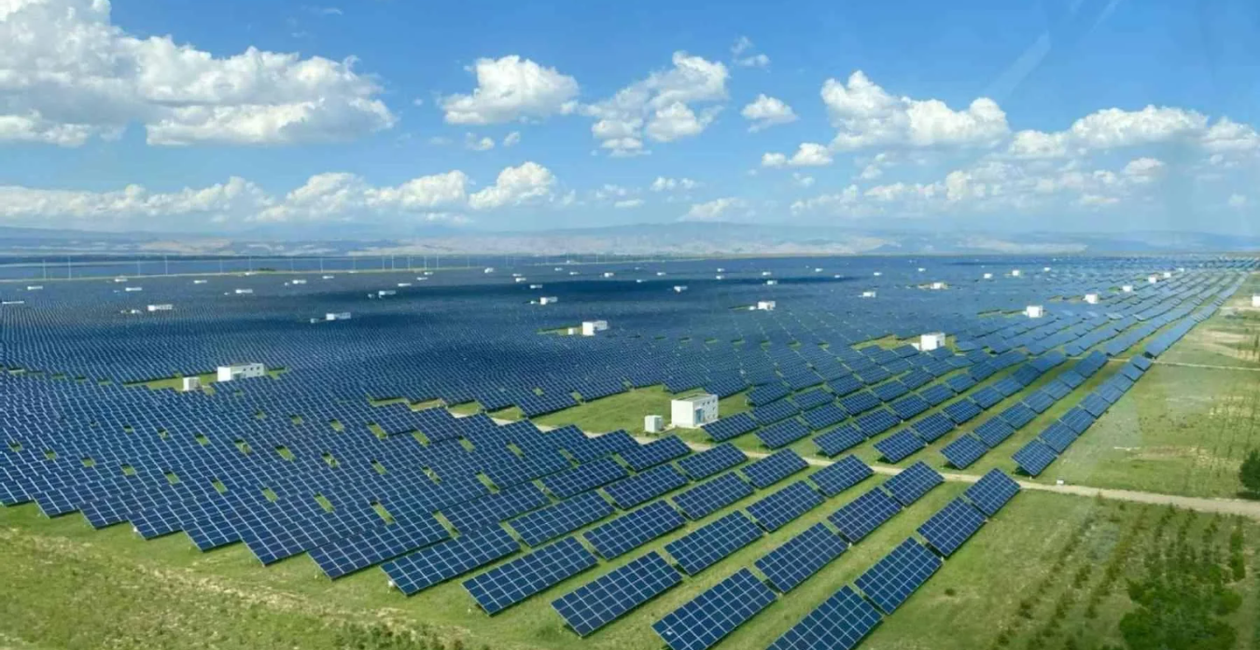
When people first see the headline about China covering 162 square miles with solar panels, the size is what grabs them. But the real story is not just scale. It is location. China did not put this project on the Tibetan Plateau just because there was empty space. It built there because the region offers a rare mix of strong sunlight, high altitude, cooler operating conditions, room for utility-scale development, and connections to a bigger renewable-energy system built around solar, wind, hydropower, storage, and long-distance transmission.
The project most often tied to this headline is Talatan Solar Park in Gonghe County, Qinghai Province. Newsweek describes it as a 162-square-mile complex, roughly seven times the size of Manhattan, sitting nearly 10,000 feet above sea level with about 7 million solar panels. Public reports differ a bit on the exact capacity and the number of homes it can power, which is common with very large projects, but they agree on the bigger point: this is one of the world’s most ambitious solar clusters and a clear example of how China is thinking about energy at national scale.
The first reason is straightforward. Solar works best where sunlight is abundant and consistent, and the high plateau gives China exactly that. Newsweek says the project benefits from sunlight amplified by thin, high-altitude air, while reference material on Talatan Solar Park describes the area as a high-altitude, semi-arid environment with strong solar irradiation. That combination matters because solar developers are not just looking for land. They are looking for land that can generate a lot of electricity per square mile.
There is also a temperature advantage that casual readers often miss. Solar panels generally perform better in cooler conditions than in extreme heat. So even though the plateau gets intense sun, the cooler air helps the equipment operate more efficiently than it might in a much hotter lowland desert. That makes the site attractive from a pure engineering perspective, not just a visual one. In other words, the plateau is not just dramatic geography. It is practical geography.
The second reason is land. Massive solar projects need huge contiguous areas, and that is hard to find near dense cities or productive farmland. Talatan and the surrounding parts of Qinghai offer large stretches of sparsely populated, desertified, or otherwise marginal land that can host utility-scale infrastructure more easily than crowded eastern provinces. Searchable reference material on the park specifically describes Gonghe County as low-density and marked by extensive desertified land, while broader reporting on China’s desert solar push shows the country increasingly favors arid western land partly because it preserves arable land elsewhere.
That land-use logic is becoming more important, not less. Reuters reported that China plans to add large amounts of solar in desert regions between 2025 and 2030 and has rules that steer projects away from arable land. That helps explain why a remote plateau site makes strategic sense. A place like Talatan lets China build at extraordinary scale without making the same kind of direct land-use tradeoff it would face in more productive agricultural zones.
Another reason China built there is that the project is not meant to operate in isolation. Newsweek and CarbonCredits both describe the plateau solar cluster as part of a broader renewable complex tied to nearby wind turbines, hydropower, battery storage, and high-voltage transmission. That matters because the biggest criticism of solar has always been intermittency. The sun is not constant. Grids still need stable supply. China’s answer here appears to be scale plus integration.
This is where the site becomes more than a big renewable photo opportunity. CarbonCredits describes the setup as part of a “solar-hydro hybrid” model, where solar is paired with storage and other generation to smooth out supply when clouds roll in or night falls. Newsweek adds that high-voltage lines send power more than 1,000 miles to urban centers. So the point is not simply to make electricity on a sunny plateau. The point is to produce it cheaply at scale and then move it where the demand actually is.
The plateau project also makes sense when you zoom out. EIA reported that China’s utility-scale solar capacity reached more than 880 gigawatts in 2024, and that it added 277 gigawatts in that year alone. That is an astonishing number. It shows that the plateau buildout is not an isolated prestige project. It is part of a much bigger national push that is reshaping China’s power mix and its industrial position in the global energy market.
That broader strategy helps explain the speed. CarbonCredits says Chinese planners use centralized planning, preferential financing, and coordinated transmission development to move very large projects faster. Whether someone sees that as efficient policy or heavy state direction, it clearly affects outcomes. Big renewable systems are easier to build when financing, land access, transmission, and industrial policy all point in the same direction.
There is also a modern demand story here. Newsweek says low-cost renewable electricity from the plateau directly benefits corporate data centers and AI infrastructure, both of which are energy-intensive. That means this solar cluster is not only about climate goals. It is also about powering the next wave of digital infrastructure without leaning as heavily on coal. In that sense, the project sits at the intersection of climate policy, industrial policy, and technological competition.
It would be too simple to portray the buildout as a pure win with no tradeoffs. Large renewable projects still raise questions about ecology, transmission buildout, and local communities. CarbonCredits notes criticism around fragile high-altitude ecosystems and local impacts, while Reuters has reported more broadly that China is increasingly using solar development in arid regions as part of desert-control strategy, with the goal of reducing wind erosion and preserving farmland elsewhere. Those are serious environmental and land-management claims, but they also show that the project is doing more than one job at once.
That tension is part of what makes Talatan Solar Park so interesting. It is both an energy project and a land-use project. It is a climate story, a grid story, and an industrial-policy story at the same time. That is why the headline matters. Not because China built something huge, but because it built it in a place that reflects how it thinks about geography, infrastructure, and long-term power supply.
The simplest answer is this: China built 162 square miles of solar panels on the Tibetan Plateau because the plateau gives it what utility-scale renewables need most. Strong sunlight. Cooler operating conditions. Vast open land. Room to connect solar with wind, hydropower, batteries, and transmission. And enough distance from crowded population centers to build at a scale that would be much harder elsewhere. Once you add China’s willingness to coordinate land, finance, manufacturing, and grid planning, the choice starts to look less surprising and more inevitable.