
 By Admin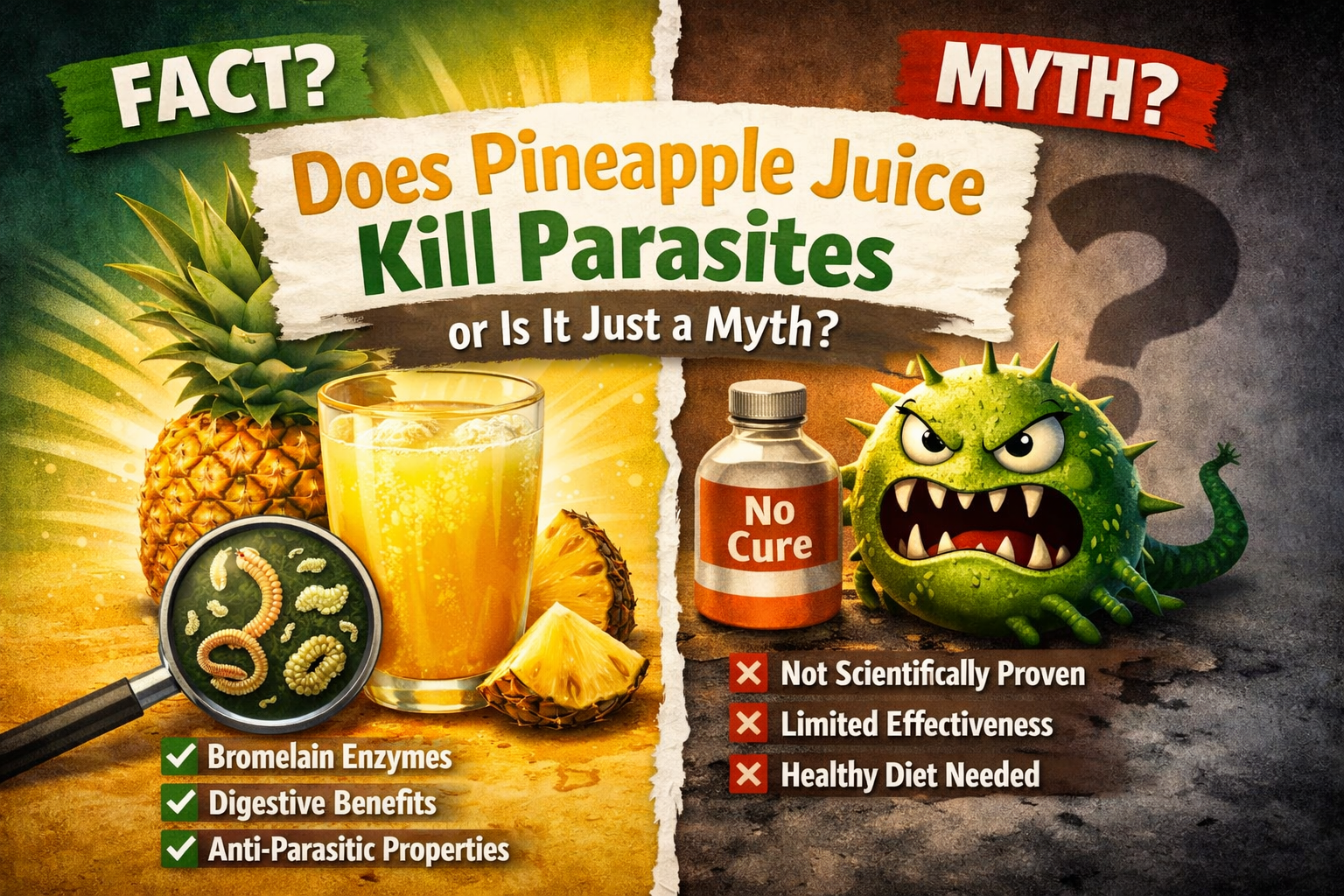
The idea that pineapple juice can kill parasites has been around for a long time, which is probably why it still shows up in search results, wellness blogs, and social posts. There is a real reason the claim exists, but the internet version usually oversells it. If you are asking whether drinking pineapple juice is a proven way to treat a parasite infection in humans, the evidence is not strong enough to say yes.
A big part of the confusion comes from the word parasites itself. Cleveland Clinic notes that intestinal parasites include both worms and single-celled organisms such as Giardia and Entamoeba histolytica. That matters because most of the pineapple claim is really about worms, not every kind of intestinal parasite people might mean when they use the word casually.
Much of the modern claim traces back to an old TIME report from 1939. It described a laboratory experiment involving Ascaris lumbricoides, where researchers Julius Berger and Conrado Frederico Asenjo found that fresh pineapple juice digested worms in a jar over 24 hours, while heat-inactivated juice and salt water did not. The article attributed that effect to an enzyme in fresh pineapple juice that was destroyed by heat. That is interesting history, but it is still a lab-style observation, not modern proof that pineapple juice reliably treats human infections.
There is also some broader scientific interest in plant enzymes. A PMC-indexed review describes plant cysteine proteinases as potential novel anthelmintics, and pineapple shows up in that research trail because of bromelain. So the claim is not completely made up. There is at least a plausible biological reason people connect pineapple with worm-killing activity.
Bromelain is a group of enzymes found in pineapple, especially associated with protein breakdown. That is why wellness pages often say it may help damage or digest the outer structures of certain worms. The problem is that biological plausibility is not the same thing as clinical proof. A substance can show interesting behavior in a lab, or even in animal work, without becoming a reliable treatment for people who have confirmed parasite infections.
That is the key line many competing articles blur. They move from “this enzyme may have anthelmintic activity” to “pineapple juice kills parasites” as if those are the same statement. They are not. One is an early scientific clue. The other sounds like a settled medical recommendation, and current treatment guidance does not back that up.
If someone really has an intestinal parasite infection, mainstream medical guidance points to testing and targeted medicines, not pineapple juice. MedlinePlus says a positive ova and parasite test identifies the type of parasite and that treatment depends on the parasite and the person’s overall health. It also notes that several stool samples may be needed because parasites do not always show up in every sample.
For common soil-transmitted helminths, the CDC says infections such as ascariasis, whipworm, and hookworm are treatable with medication. The agency lists drugs such as albendazole, mebendazole, ivermectin, and pyrantel pamoate as treatment options.
Mayo Clinic says ascariasis treatment usually involves anti-parasite medicines, most commonly albendazole, mebendazole, or ivermectin. Cleveland Clinic adds that most intestinal parasite infections need prescription antiparasitic drugs, and for protozoa the medicines may be different again, such as metronidazole or tinidazole, depending on the organism.
That difference is important because it shows why the phrase “pineapple juice kills parasites” is too broad to be medically useful. Different parasites behave differently, are diagnosed differently, and are treated differently. A home remedy claim does not match that reality very well.
If the claim is phrased as “there is some older and early evidence suggesting pineapple-related enzymes may affect certain worms,” that is not pure myth. If the claim is phrased as “drinking pineapple juice is a proven treatment for parasite infections in humans,” that is where it becomes misleading. The stronger, more honest answer is that pineapple juice may have inspired real scientific interest, but it is not established as a standard treatment for human parasite infections.
In practical terms, that means pineapple juice belongs closer to the “interesting food claim” category than the “reliable medical fix” category. It may be fine as part of a normal diet for many people, but it should not be treated as a substitute for diagnosis or evidence-based treatment.
Part of the reason this claim survives is that it sounds simple and natural. People like the idea that something sweet, familiar, and easy to find could solve a problem that feels unpleasant or embarrassing. It also helps that the claim has a memorable old-school science story behind it, which makes it sound more solid than many wellness myths.
Another reason is that “parasites” is often used online as a vague catch-all for bloating, stomach upset, fatigue, or general digestive discomfort. But Cleveland Clinic notes that symptoms can vary widely and that some infections cause no symptoms at all. That means self-diagnosing from internet content is risky, especially when the real issue might be something other than a parasite in the first place.
If you truly suspect an intestinal parasite, the smarter move is to get checked rather than trying to self-treat with juice. MedlinePlus explains that stool testing can identify parasites and eggs, and Cleveland Clinic says stool tests are often the main tool providers use to diagnose intestinal parasites.
This is especially important if you have ongoing diarrhea, abdominal pain, bloating, nausea, anal itching, dehydration, or recent travel or exposure risks. Cleveland Clinic says some untreated infections can lead to complications such as malnutrition, anemia, bowel obstruction, or organ damage in certain cases.
Pineapple juice is not a proven cure for parasites in humans. There is some older lab evidence and some scientific interest around bromelain and plant enzymes, especially for certain worms, but that is not the same as established medical treatment. If the question is whether pineapple juice can replace proper diagnosis and antiparasitic medicine, the answer is no.The safest way to think about it is this: the claim has a kernel of scientific history behind it, but the strong internet version is mostly myth. When an actual parasite infection is on the table, CDC, MedlinePlus, Mayo Clinic, and Cleveland Clinic all point back to testing, identification, hydration, and the right medication for the specific organism.