
 By Admin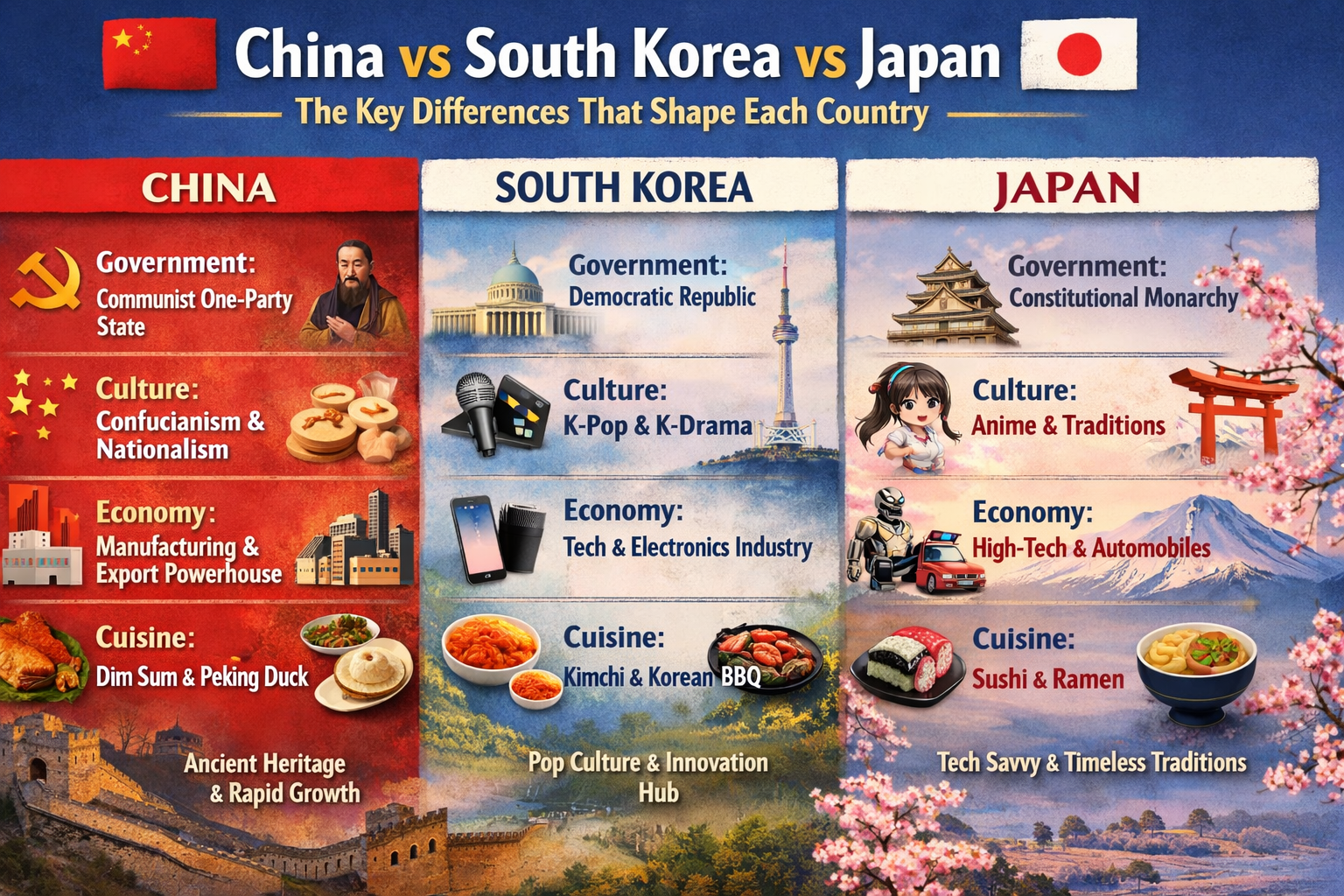
When people compare China, South Korea, and Japan, they often start with food, pop culture, or travel. But the deeper differences run through scale, political structure, geography, security ties, and historical memory. That is also how the region is being talked about right now. The three countries revived high-level trilateral diplomacy in Seoul in 2024, designated 2025 to 2026 as a cultural exchange period, and followed that with another foreign ministers’ meeting in Tokyo in 2025. At the same time, relations remain tense around trade, Taiwan, and strategic rivalry, with South Korea often caught in the middle.
The first thing that separates China from the other two is size. The World Bank lists China’s 2024 population at about 1.41 billion, compared with about 124 million for Japan and about 51.8 million for South Korea. Britannica also lists China’s area at roughly 9.57 million square kilometers, which makes it feel less like a single compact nation-state and more like a continent-sized system with major regional variation inside it.
That scale shapes almost everything about China. It affects how the state governs, how infrastructure is built, how regional economies differ, and how national policy tends to be framed in long, strategic terms. A country that large has to think in layers, from global manufacturing and trade to internal provincial differences and demographic pressure. Even its social picture looks different from its neighbors. The World Bank shows life expectancy at 78 in China, compared with 84 in both Japan and South Korea, which hints at different development pressures and social structures across the region.
If China feels continental, South Korea feels compressed. Britannica lists the country’s area at just over 100,000 square kilometers, and its capital, Seoul, dominates national life in a way that has no real equivalent in China and only a partial equivalent in Japan. With a population a little above 51 million, South Korea is much smaller than either neighbor, but that smallness has produced a country that often feels extremely dense, wired, competitive, and quick to change.
That compactness matters. It helps explain why trends in South Korea can move so fast, why politics can feel unusually intense, and why the country often punches above its weight diplomatically and economically. In current regional coverage, TIME describes South Korea as a focal point between China and Japan, while analysts describe Seoul as a balancing player and even a diplomatic hub. That is a very South Korean position: not the biggest country in the room, but often the one whose choices matter most.
Japan stands apart in a different way. Britannica describes it as an island country of more than 6,000 islands, with a constitutional monarchy and parliamentary system, while the World Bank puts its 2024 population at roughly 124 million and life expectancy at 84. Geography matters here. Japan is not a continental state like China, and it is not a compact peninsula state like South Korea. It is an archipelago, and that island reality has long shaped how it thinks about security, trade, and national identity.
It is also a country where institutions matter deeply. Britannica notes that the emperor is symbolic and power is exercised through elected officials and the Diet, while the same source also points to a declining and aging population. That combination gives Japan a distinct character in East Asia. It is highly advanced, highly structured, and often cautious in tone, even when its security posture is changing. Compared with South Korea, it usually feels more institution-first. Compared with China, it feels less centralized in political style and far less continental in outlook.
One of the clearest differences between the three is political structure. Britannica describes China as a single-party people’s republic, Japan as a constitutional monarchy with a parliamentary system, and South Korea as a unitary multiparty republic. Those are not small distinctions. They shape how leaders rise, how policy is debated, how power is distributed, and how quickly governments can shift direction.
In practice, this means China often projects long-range state direction more clearly, while Japan and South Korea are more visibly shaped by elections, party competition, and public mood. That is one reason the three countries can sit at the same diplomatic table and still arrive there with very different political instincts. Even when they agree on trade or cultural exchange, they are not coming from the same internal system.
Another major difference is the security map. Reuters describes Seoul and Tokyo as key U.S. allies amid intensifying rivalry between the United States and China. That alone separates Japan and South Korea from China, which is not part of that alliance structure and is increasingly central to the rivalry itself.
This is where the comparison becomes especially real. TIME reports that South Korean President Lee Jae-Myung has been trying to normalize ties with China while preserving cooperation with Japan and the United States, and it describes this as a balancing act. The same report says tensions between China and Japan worsened over Taiwan, export controls, rare earths, and travel warnings. So while all three countries are neighbors, they do not sit in the same strategic position. Japan is leaning harder into alliance coordination, South Korea is trying to keep room to maneuver, and China is approaching the region as a major power with its own strategic agenda.
History is not background noise here. It is active political material. In the current TIME coverage, Xi Jinping is quoted framing relations with South Korea partly through the legacy of World War II and Japanese military aggression. That tells you something important: the past is not just remembered differently in these countries, it is used differently too.
For Japan, modern identity is still shaped by postwar pacifism, economic rebuilding, and the burden of historical memory. For South Korea, history includes Japanese colonial rule, division of the peninsula, and a strong sensitivity to sovereignty and external pressure. For China, modern history is tied to national revival, territorial integrity, and a state narrative that links memory to power. The same event can live very differently in each national story, and that is one reason trilateral diplomacy is always more fragile than it first appears.
It would be wrong to treat the three countries as permanent antagonists. The official 2024 joint declaration from the Ninth ROK-Japan-China Trilateral Summit emphasized youth exchange, public diplomacy, cultural cooperation, and the designation of 2025 to 2026 as the Year of Cultural Exchange. That matters because it shows the three governments understand something basic: geography keeps them tied together, even when politics pulls them apart.
But even cooperation reveals their differences. Reuters reported that the 2025 foreign ministers’ meeting in Tokyo focused on “future-oriented cooperation” while also acknowledging the regional and international tensions surrounding the talks. That phrasing is telling. China, South Korea, and Japan can cooperate, but usually in a way that is cautious, layered, and shaped by everything they cannot easily solve.
The simplest way to understand the three countries is this. China is shaped by scale, centralized power, and major-power ambition. South Korea is shaped by compactness, democratic intensity, and the need to balance bigger players without losing room to act. Japan is shaped by island geography, institutional continuity, and a postwar identity that is slowly adapting to a harder security environment. Those are the key differences that shape each country, and they explain why these neighbors can look similar from a distance while behaving very differently up close.