
 By Admin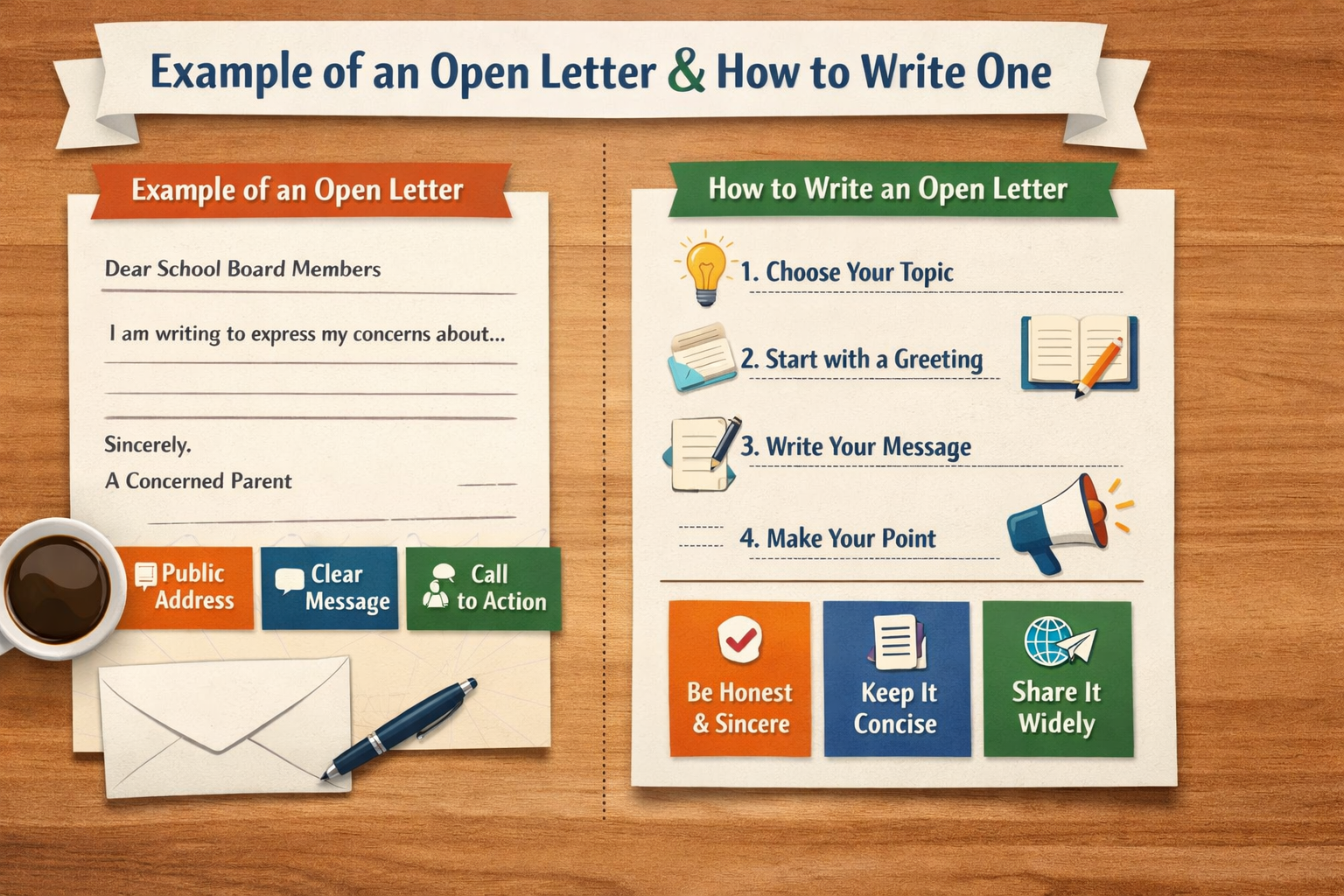
If you have ever wanted to speak directly to a person in power, a company, a school, or even your wider community, an open letter can be one of the clearest ways to do it. Unlike a private letter, an open letter is written to a specific person or group but meant to be read by a wider public. That public-facing purpose is what gives the format its weight. It is both personal and public at the same time.
That is also why open letters have lasted for so long. They have been used for protest, persuasion, accountability, advocacy, and public reflection. Famous examples often mentioned in histories of the form include Émile Zola’s J’accuse…!, Martin Luther King Jr.’s Letter from Birmingham Jail, and Bill Gates’ Open Letter to Hobbyists, all of which show how a letter addressed to someone specific can shape a much larger conversation.
At its core, an open letter is a public message. It is usually addressed to a named person, institution, or group, but it is written with a second audience in mind: everyone else who may read it. Writing guides on the form often describe this as the “dual audience” of an open letter. You are speaking to one target, but you are also trying to inform, persuade, or move the wider public.
That makes the format different from a normal complaint letter or email. A private complaint is mainly about solving a problem directly. An open letter is usually about making the issue visible, creating public pressure, or inviting broader discussion. It can still be respectful, but it is almost never purely private.
An open letter works best when the issue matters beyond just you. Maybe a school policy affects a whole student body. Maybe a company decision has upset a large group of customers. Maybe a public official has the power to act, but has not responded. In situations like that, an open letter can help you explain the issue clearly, show why it matters, and state what change you want to see. Template-based advocacy guides often stress these same points: identify the problem, explain why the recipient has the power to act, and make the requested action easy to understand.
It is also useful when you want your writing to do more than vent. A strong open letter is not just emotional. It gives context, sets out an argument, and points toward a specific response or solution.
You do not need to make the format complicated. Most effective open letters follow a simple flow.
Be direct. Name the person, office, organization, or group.
Examples:
- Dear School Board
- Dear Mayor
- Dear Customer Support Team at [Company]
- Dear University Administration
This gives the letter focus right away.
In the opening paragraph, explain the issue clearly. Do not circle around it for too long. Readers should understand the topic within a few lines.
This is where you explain what happened, why it matters, and who is affected. If you have relevant facts, examples, or lived experience, include them here. Good open letters usually balance clarity with context, so the reader understands both the problem and the stakes.
Be clear about what you believe. This is the heart of the letter. If your argument gets lost, the whole piece weakens.
Do not stop at criticism. Say what you want the recipient to do. A review, a public reply, a policy change, an apology, a meeting, or a concrete action plan are all clearer than vague frustration.
Close firmly and calmly. You want the letter to feel intentional, not unfinished.
The best open letters usually share a few qualities. They are clear, specific, and easy to follow. They sound human, not stiff. They remember that the wider public is reading. And they focus on one main issue instead of trying to solve everything at once. Writing and teaching guides on open letters also emphasize voice, context, audience awareness, and a clear central message.
A few practical tips help a lot:
Write like a real person, not like a corporate memo.
Keep the tone firm but controlled.
Use short paragraphs so the message feels readable.
Include a clear ask.
Do not rely only on anger.
Remember that people beyond the recipient are judging your credibility too.
Here is an original sample you can use as a model:
Dear School Administration,
I am writing this open letter as a student who cares deeply about the learning environment at our school. Over the past several months, many students have raised concerns about the lack of quiet study space after classes end. Right now, the library closes too early, common areas are often crowded, and students who need a calm place to work are left with very few options.
This might sound like a small issue from the outside, but for many students it affects daily life. Some of us stay late because of clubs, sports, or long commutes. Others depend on school spaces because home is not always the easiest place to focus. When those spaces are limited, the result is frustration, lower productivity, and a feeling that student needs are being overlooked.
I do not believe this problem exists because the administration does not care. More likely, it has not been treated as urgent enough. That is exactly why I am writing publicly. This is not just one student’s inconvenience. It is a shared issue that affects learning, fairness, and student well-being.
I respectfully ask the administration to consider three simple steps: extending library hours at least two days a week, setting aside one supervised classroom as a quiet study room, and asking students for feedback on what kind of after-school study access would help most.
Students are not asking for luxury. We are asking for a reasonable environment where we can do the work we are already being encouraged to take seriously.
I hope this letter opens the door to a constructive response and a practical solution.
Sincerely,
A Concerned Student
This sample works because it does a few important things well. It names the recipient, explains the issue quickly, gives context, keeps the tone respectful, and ends with specific requests. That balance matters. Many open letters fail because they either become too emotional and vague or too formal and lifeless. A good one sounds like a person who knows what they are asking for.
A weak open letter usually falls into one of these traps:
It tries to cover too many issues at once.
It never clearly says what the writer wants.
It sounds more like a rant than a reasoned public message.
It forgets that outside readers need background.
It uses big feelings but no clear structure.
If you avoid those mistakes, your letter already has a much better chance of being taken seriously.
An open letter is not just a letter with a dramatic title. It is a public-facing piece of writing that blends direct address with wider persuasion. The format has lasted because it is flexible. It can be used for activism, accountability, education, protest, and even personal reflection, as long as the writer understands the real goal: to say something to one audience in a way that matters to many.
If you want your own open letter to work, keep it simple. Be clear about the issue, clear about the audience, and clear about the action you want next. That is what turns a public message into one people actually remember.