
 By Admin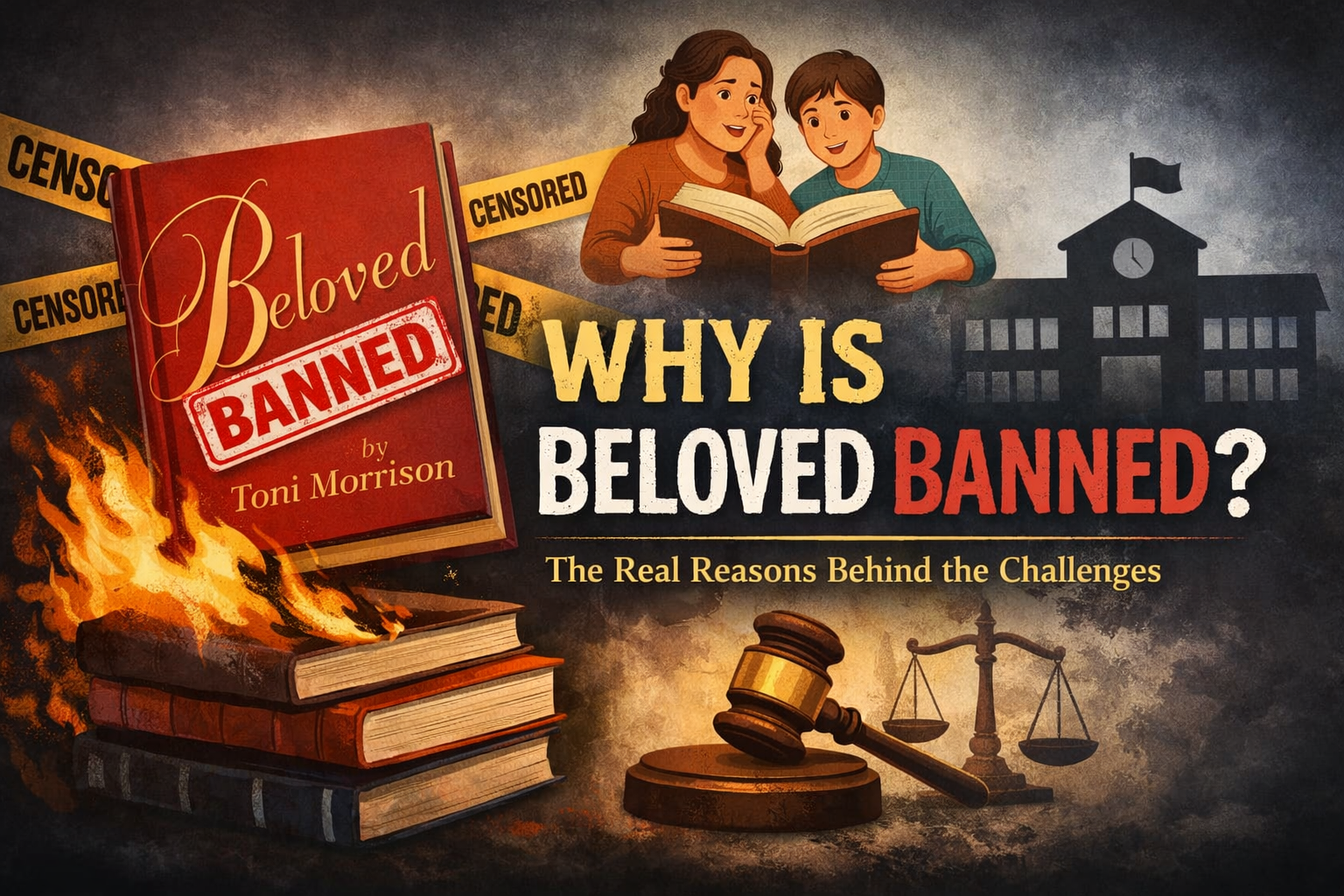
When people ask why Beloved is banned, the first thing worth clearing up is the wording. In many cases, Beloved has been challenged, restricted, removed from certain classes or libraries, or targeted for removal rather than permanently banned everywhere. The American Library Association defines a challenge as an attempt to remove or restrict materials and a ban as the actual removal of those materials. That distinction matters because it helps explain why the book keeps returning to public debate.
The short answer is that Toni Morrison’s Beloved is usually challenged for its sexually explicit material, violence, and scenes some adults consider too graphic for students. The ALA has listed Beloved among its most challenged books and gave the reasons as sexually explicit, religious viewpoint, and violence.
But that is only part of the story. The deeper reason Beloved keeps getting targeted is that it confronts slavery, Black history, and racial trauma in a direct, emotionally difficult way. TIME says scholars see Morrison’s books as frequent censorship targets because they force readers to face painful parts of American history without softening them, while CBS News notes that books about race are often attacked under the false label of critical race theory.
It would be misleading to pretend the challenges come from nowhere. Beloved does contain disturbing material, and that is one reason it draws complaints. CBS News reported that the novel contains violent and sexually explicit passages, and Wikipedia summarizes specific objections in school controversies that focused on violent sex, including references to gang rape, and material considered too graphic for teenagers.
That is why some parents, school boards, and political figures frame their objections around age appropriateness. They argue that certain scenes are too intense for high school classrooms or school libraries. On the surface, that sounds like a straightforward concern about student readiness. In practice, though, the controversy around Beloved rarely stays that narrow for long.
What makes Beloved different from many other challenged books is that its hardest material is tied directly to the historical reality of enslavement. Picturing Black History argues that the novel is praised and suppressed for the same reason: it forces readers to confront slavery, Black resistance, and the afterlife of racial violence in ways that are hard to ignore. TIME makes a similar point, saying Morrison’s work regularly becomes controversial because it deals head-on with some of the darkest moments in American history.
That helps explain why the debate around Beloved often feels bigger than one book. The fights over it are not only about explicit scenes. They are also about what kinds of historical truth schools are willing to teach, what kinds of pain students are expected to confront, and whether literature centered on Black suffering and memory is treated as essential education or as a problem to be managed.
Part of what makes the issue striking is that Beloved is not an obscure or fringe novel. It is one of Toni Morrison’s most celebrated works, and TIME describes Morrison as a towering figure in American literature whose books have nevertheless remained frequent ban targets. Picturing Black History adds that Beloved appears in more than 1,500 syllabi and is central to around 1,000 scholarly works, which shows how firmly it is embedded in academic and literary culture.
That tension is really the heart of the controversy. The same book that many teachers, scholars, and readers see as essential is also viewed by opponents as too graphic, too unsettling, or too politically charged. In other words, Beloved is challenged not despite its importance, but often because of it. Books that matter deeply are often the ones that provoke the strongest reaction.
The book’s national profile in censorship debates has also been shaped by specific public fights. Wikipedia notes a 2007 complaint in Kentucky over language in an AP English class and later controversy in Virginia over sexual violence in the novel. That Virginia dispute became politically visible enough to feed into the debate around the so-called Beloved Bill, which would have required schools to notify parents about sexually explicit material and offer alternative assignments.
Those cases matter because they turned Beloved from a classroom reading choice into a symbol in larger political battles. Once that happens, the conversation usually stops being only about literary judgment. It becomes part of a broader culture-war argument about parents’ rights, school control, race, and what public education should look like.
People who defend Beloved usually do not deny that it is difficult. Their argument is that difficulty is part of the book’s purpose. Picturing Black History treats the novel’s repeated suppression as evidence of discomfort with the truths it tells, and CBS News quotes Deborah Stone of the ALA Office for Intellectual Freedom saying the book is not pornographic or obscene even though it deals with sex.
That defense matters because it reframes the issue. The question is not whether Beloved is disturbing. It clearly is. The question is whether disturbing literature about slavery and racial trauma should be removed because it makes readers uncomfortable. Supporters argue that removing it treats discomfort itself as a reason for censorship, which is a very different standard from deciding whether a book has educational or literary value.
The most honest answer is that there are two layers to why Beloved gets challenged. The visible layer is the one challengers usually name first: sexual content, violence, and graphic scenes they consider unsuitable for students. The deeper layer is the book’s unflinching portrayal of slavery, Black suffering, and the psychological legacy of racial oppression. That second layer is why the controversy keeps returning and why the novel is so often swept into larger fights over race and education.So when people ask why Beloved is banned, the real answer is not just “because it has explicit content.” That is part of it, but not enough to explain the full pattern. Beloved keeps getting challenged because it is both graphically difficult and historically uncompromising. It forces readers to sit with brutality that many would rather keep at a distance. And that is exactly why the book still matters.