
 By Admin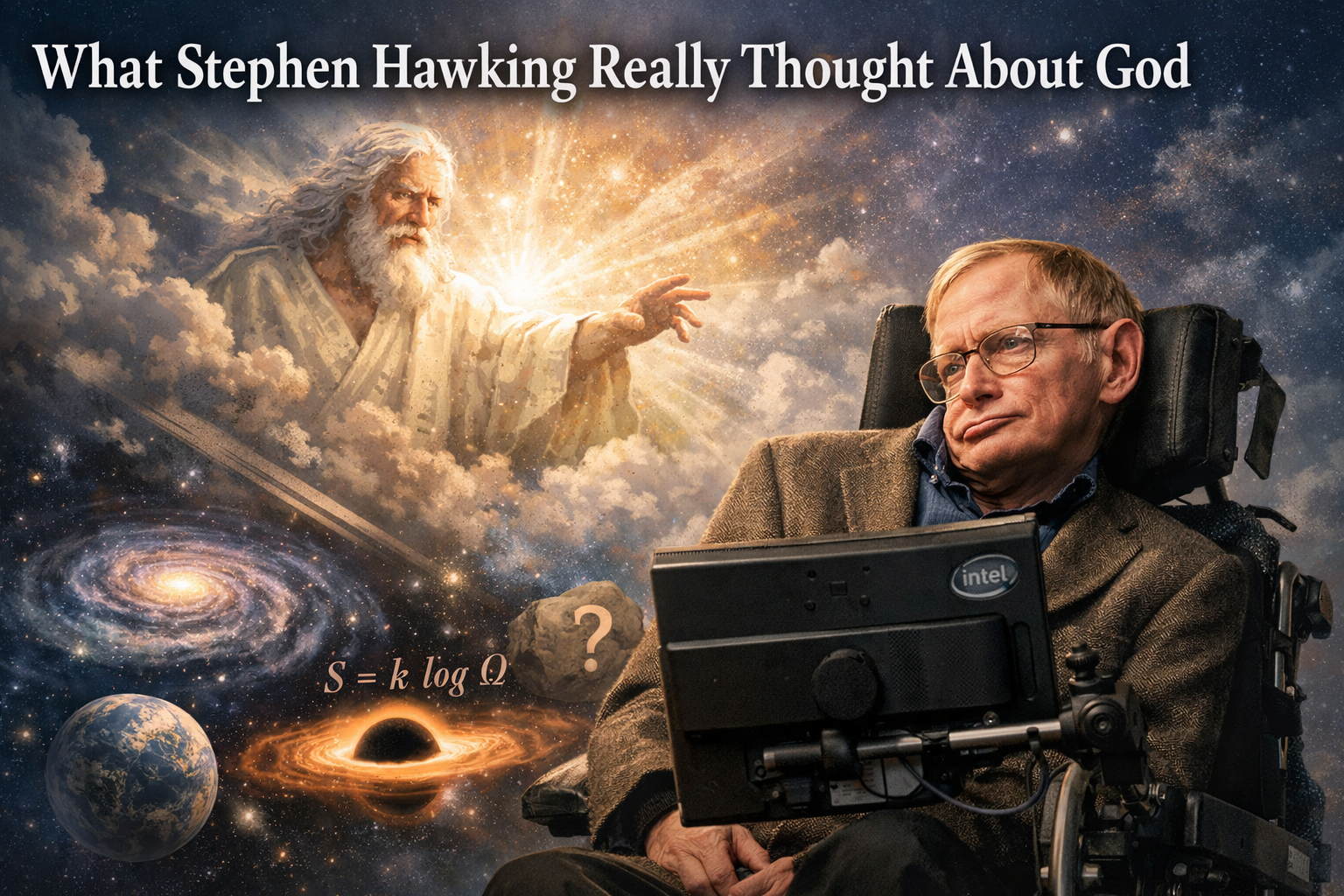
A lot of people still ask whether Stephen Hawking believed in God, partly because he sometimes used God-language in his books, and partly because people often assume a scientist’s views on religion must be more complicated than a simple yes or no. In Hawking’s case, the broad answer is actually pretty clear. In his later public statements, he said science gave a better explanation for the universe than a creator, rejected the idea of a personal God, and explicitly identified himself as an atheist.
By the end of his life, Stephen Hawking was not speaking vaguely or indirectly on this subject. In a 2014 interview summarized by multiple reputable outlets, he said that before people understood science, it was natural to think God created the universe, but that science now offered a more convincing explanation. In that same line of thought, he clarified that when he once wrote about knowing the “mind of God,” he did not mean a real divine being. He added that, if there were a God, we would know what that God knew, “which there isn’t,” and said plainly, “I’m an atheist.”
The confusion mostly comes from A Brief History of Time and other moments when Hawking used religious language in a poetic or metaphorical way. That style made some readers think he might believe in some higher power after all. But later explanations make his meaning much clearer. TIME notes that he used God more as shorthand for the deepest laws of the universe than as a personal creator who listens, judges, or guides human lives. In other words, he sometimes borrowed religious vocabulary, but he was not endorsing traditional religious belief.
This is really the center of Hawking’s view. He believed the universe could be explained through the laws of physics rather than through divine intervention. That idea became especially visible around The Grand Design, where he argued that modern physics made it possible to explain the universe without invoking a creator. Later summaries of his views repeatedly return to the same point: he did not think a supernatural being was necessary to explain why the universe exists or how it began.
That does not mean Stephen Hawking thought life was meaningless. This is where people sometimes misread him. He rejected a divine designer, but he did not reject wonder, curiosity, or purpose. In fact, the same coverage that summarizes his atheism also shows that he spoke often about finding meaning through understanding the universe, staying curious, doing worthwhile work, and not giving up. His worldview was secular, but it was not empty.
Hawking’s position here was just as direct. In a 2011 interview with The Guardian, he said there was no heaven or afterlife for “broken-down computers,” comparing the brain to a machine that stops working when its parts fail. He called belief in an afterlife a “fairy story” for people afraid of death. TIME and National Catholic Reporter both echoed this same position in their retrospectives, making it clear that he did not believe consciousness continues after death in a religious sense.
That part of his thinking was consistent with his larger view of reality. For Hawking, human beings were physical creatures in a lawful universe, not souls temporarily living inside bodies. So when he rejected heaven, he was not making an offhand remark. He was following the same logic he used in his scientific worldview: claims about reality should have evidence behind them, and he did not think there was reliable evidence for a supernatural afterlife.
Another key part of understanding Stephen Hawking is recognizing that he did not see science and religion as two equal ways of explaining the same things. He repeatedly leaned toward science as the stronger route because it depends on observation, reason, and testable ideas. This is why his comments about God were not just personal preference. They came out of a larger belief that the universe is better understood through evidence than through revelation or authority.
That perspective also helps explain why he became publicly associated with organized humanism. Humanists UK described him after his death as someone who was explicit about his atheist and humanist approach to existential questions, and noted that his reflections on an unguided universe and death as the end of consciousness appeared again and again in his public statements and writing. That is an important detail because it shows his atheism was not a one-off media headline. It was part of his settled worldview.
The clearest way to put it is this: Stephen Hawking did not believe in a personal God, did not think the universe required a creator, did not believe in heaven or an afterlife, and ultimately described himself as an atheist. At the same time, he still used big, thoughtful language about existence, wonder, and the beauty of trying to understand reality. That is why people sometimes misread him. He spoke with awe about the universe, but that awe was directed at the cosmos itself, not at a divine being behind it.
In the end, what Stephen Hawking really thought about God was simpler than the debate around him makes it seem. He respected the power of the question, but he did not accept the religious answer. For him, the universe did not point to a creator. It pointed to laws, mystery, and the human drive to understand as much as we can while we are here.